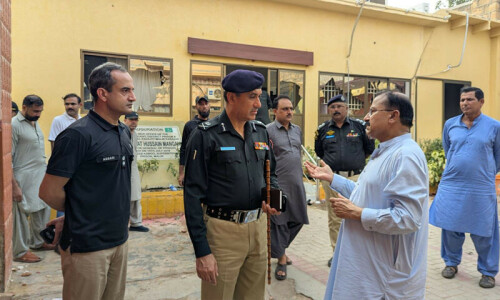
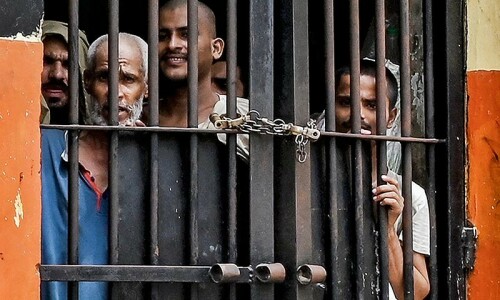
A THOROUGH audit of correctional facilities in Sindh — as well as other parts of the country — is in order after the recent jailbreak in Karachi’s Malir District Prison. Over 200 inmates escaped from the facility after the city experienced slight tremors late Monday and early Tuesday.
Prisoners were allowed into the jail’s courtyard after the minor quakes and from there all hell broke loose, as the inmates overpowered the guards and made for the exits. As per news agencies, there were only 28 guards on duty to watch over 2,000 prisoners, while the jail’s security cameras were also reportedly not functioning. At the time of writing, a significant number of escapees remained at large.
As the Sindh chief minister said, the jailbreak represented a “complete breakdown in communication and preparedness”. The Sindh government says the escaped prisoners were involved in “minor offences”. The threat to public safety would have been considerably higher had these escapees included hard-core militants, or those involved in heinous crimes.
The episode reveals that our penitentiaries are woefully underprepared for emergency situations. The jail staff should have been trained to safely evacuate prisoners in case of natural disasters or other emergencies, while also ensuring they remained under the watch of law enforcers. Instead, what was witnessed was panic and a state of total unpreparedness. The incident again underscores the need to speed up jail reforms countrywide.
In many instances, our jails are still run under colonial frameworks. Overcrowding is common, while facilities contain under-trial prisoners as well as convicts. When jails have far more inmates than they can safely accommodate, mismanagement and chaos are natural corollaries. Speeding up trials and keeping probation options open for those involved in minor crimes should be considered. It is a fact that a broken legal and criminal justice system results in overcrowded and poorly managed jails.
Jail security also needs to be beefed up. The episode in Malir has shown that there are major lacunae concerning prison security. The Sindh authorities need to ensure that all the escaped prisoners are recaptured soon. In the past, the massive Bannu jailbreak showed that when the state lets its guard down, violent elements exploit loopholes — with terrifying consequences.
The chief justice of Pakistan is leading efforts to reform penitentiaries. These efforts must examine all proposals designed to ensure prisoners’ welfare and rehabilitation, as well as address loopholes in the security of prisons. Once these recommendations have been finalised, the chief justice should ensure that the federal and provincial governments implement them without delay.
The Malir jailbreak cannot be ignored, and should lead to visible changes in jail security and management.
Published in Dawn, June 5th, 2025