Pakistan, India close to completing border troop reduction: CJCSC Gen Mirza

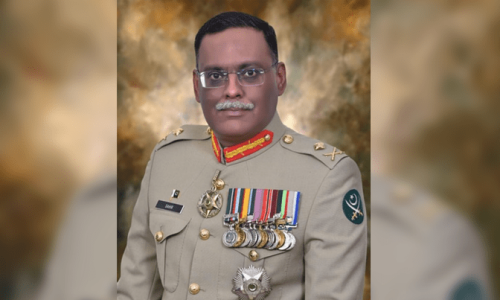
Pakistan and India are close to reducing the troop build-up along their border to levels before conflict erupted between the nuclear-armed neighbours this month, General Sahir Shamshad Mirza, chairman of the Joint Chiefs of Staff Committee told Reuters on Friday, although he warned the crisis had increased the risk of escalation in the future.
The developments follow a recent military confrontation between India and Pakistan over New Delhi’s allegations against Islamabad, without evidence, about a deadly attack in occupied Kashmir’s Pahalgam. New Delhi, based on the allegations, launched a series of air strikes in Pakistan in early May, killing civilians. Islamabad retaliated by downing five Indian jets. After intercepting drones sent by India and tit-for-tat strikes on each other’s airbases, it took American intervention on May 10 for both sides to finally reach a ceasefire.
Gen Mirza said the two militaries had started the process of drawing down troop levels.
“We have almost come back to the pre-22nd April situation… we are approaching that, or we must have approached that by now,” said Mirza, the most senior Pakistani military official to speak publicly since the conflict.
India’s ministry of defence and the office of the Indian chief of defence staff did not immediately respond to Reuters’ requests for comment on the remarks by Mirza.
Mirza, who is in Singapore to attend the Shangri-La Dialogue forum, said while there was no move towards nuclear weapons during this conflict, it was a dangerous situation.
“Nothing happened this time,” he said. “But you can’t rule out any strategic miscalculation at any time, because when the crisis is on, the responses are different.”
He also said the risk of escalation in the future had increased since the fighting this time was not limited to the Indian-occupied Kashmir.
Indian Prime Minister Narendra Modi warned Pakistan this month that New Delhi would target “terrorist hideouts” across the border again if there were new attacks on India.
“This (conflict) lowers the threshold between two countries who are contiguous nuclear powers…in the future, it will not be restricted to the disputed territory. It would come down to (the) whole of India and (the) whole of Pakistan,” Mirza said. “This is a very dangerous trend.”
Mirza warned that international mediation might be difficult in the future because of a lack of crisis management mechanisms between the countries.
“The time window for the international community to intervene would now be very less, and I would say that damage and destruction may take place even before that time window is exploited by the international community,” he said.
Pakistan was open to dialogue, he added, but beyond a crisis hotline between the directors general of military operations and some hotlines at the tactical level on the border, there was no other communication between the two countries.
India’s foreign ministry spokesperson said on Thursday “Talks and terror don’t go together” in response to a question on the possibility of dialogue with Pakistan.
Mirza said there were no backchannel discussions, or informal talks, to ease tensions. He also said he had no plans to meet General Anil Chauhan, India’s chief of defence staff, who is also in Singapore for the Shangri-La forum.
“These issues can only be resolved by dialogue and consultations, on the table. They cannot be resolved on the battlefield,” Mirza said.
India threatens to use navy against Pakistan in future
India will use the firepower of its “navy in response to any future aggression by Pakistan,” India’s defence minister said on Friday.
“If Pakistan resorts to anything evil or unethical, it will, this time, face the firepower and ire of the Indian Navy,” Defence Minister Rajnath Singh said on the aircraft carrier INS Vikrant off the coast of the western Indian state of Goa.
A spokesperson for Pakistan’s military referred Reuters to a May 12 statement, which said there would be a “comprehensive and decisive” response whenever Pakistan’s sovereignty was “threatened and territorial integrity violated”.
Singh said ‘Operation Sindoor’, under which India launched the strikes on Pakistan, was paused, but not yet over.
“We stopped our military actions on our own terms. Our forces had not even started showing their might,” he said.