Karachi mayor seeks consensus in City Council to address water crisis


 0
0

• Opposition slams KWSC for failing to ensure smooth supply
• Wahab shares plan to curb water theft from K-III pipeline
• Says out of 1.4m consumers, only 500,000 get water bills
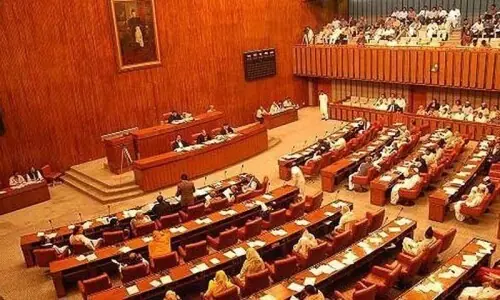
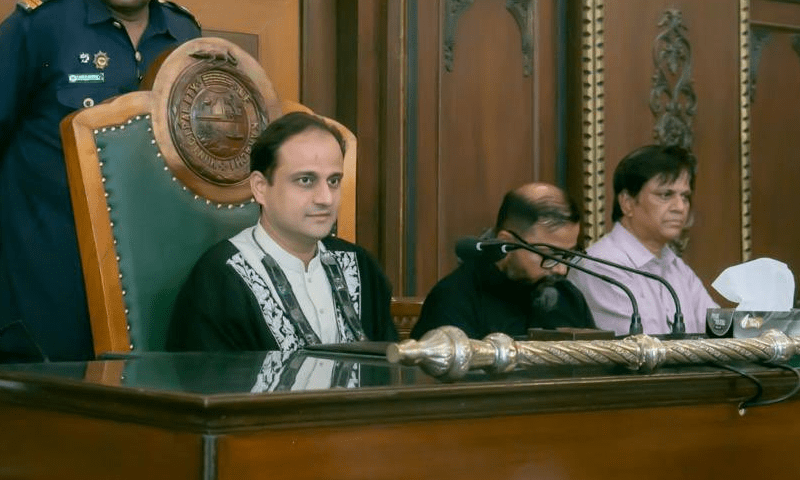
KARACHI: The city’s persistent water crisis took centre stage at the City Council meeting on Tuesday where Mayor Murtaza Wahab informed the members that the K-III water line was being elevated to curb illegal connections and water theft.
He said that joint action would be taken against water theft and urged the council members to move forward with consensus to resolve the city’s water supply issues.
The City Council meeting, presided over by the mayor, was called at the request of the opposition to discuss acute shortage of water in the city.
During the proceedings, several opposition members also criticised the Karachi Water and Sewerage Corporation (KWSC) for its failure to provide smooth water supply to the city.
The mayor, who is also the chairman of the board of the KWSC, shared that the K-III line was being rebuilt as an elevated conduit to reduce water theft. He announced strict monitoring of all water hydrant nozzles, including obtaining written affidavits from the responsible officers.
He also announced the formation of a committee comprising members from both the government and the opposition to oversee the hydrant issues.
Mr Wahab said that the city’s registered consumers were just 1.4 million, compared to KE’s 3.8m customers. “Yet, water bills are delivered to only 500,000 households and an even smaller number pay,” he noted.
He also mentioned that funding had been approved to exempt the water supply and drainage pumping stations in Lyari and Saddar Town from power outages.
The mayor said that since he assumed office, the water utility’s revenue had increased from Rs1.1 billion to Rs1.8bn.
The mayor also expressed strong reservations over the absence of the top officials of the KWSC in the meeting and lamented that despite his clear instructions in the previous meeting, the chief executive officer (CEO) and chief operating officer (COO) of KWSC were not present.
He informed the council that the Sindh High Court had suspended the appointment orders of both officers. “We have filed an emergency application to recall the court’s decision but until the matter is decided, they cannot attend the council proceedings”, he added.
However, the absence of the water utility officials did not deter the mayor to proceed with the meeting. “We will deliberate on the issues and all key points will be communicated to the relevant officers later.”
The situation took a tense turn when the mayor asked the chief engineer of the water utility to leave the session, arguing that he was not the appropriate official to respond to policy-level questions.
Opposition Leader Advocate Saifuddin protested over the mayor’s decision, urging him to allow participation of the available officials.
Zubaida Iqbal, chairperson of UC-6, Manghopir Town, demanded the installation of solar panels at pumping stations. “Due to prolonged load-shedding in our area, water supply suffers,” she said, adding that solar-powered systems could ensure uninterrupted pumping and reduce waste.
Council member Najmi Alam informed said that a significant portion of water was being consumed by informal settlements, commonly known as katchi abadis, which were not billed at normal slab rates.
Mr Alam said that a major chunk of city’s water was being consumed by unregulated neighbourhoods and called for an end to the disparity between regularised and informal settlements. “We cannot sustain KWSC without expanding the tax net,” he added.
He said that people were illegally installing pipelines and charging for water in some parts of district West.
Mr Alam also raised critical concerns regarding the financial viability of the water utility. “The corporation’s monthly billing barely touches Rs600m, which is insufficient for its operational needs,” he said, adding that there were over 400 vacant posts in the revenue department and billing coverage remained abysmally low.
The house was later adjourned to Friday to continue the debate on the water crisis.
Published in Dawn, May 28th, 2025