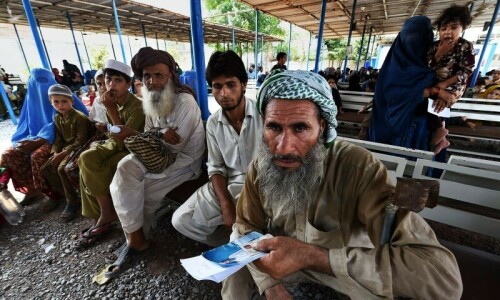
ISLAMABAD: The United Nations High Commissioner for Refugees (UNHCR) office has said some 110,000 refugees and asylum-seekers in Pakistan, including a minimum of 8 per cent of Proof of Registration (PoR) cardholders, have both high-risk profiles with increased international protection needs, and specific or cumulative vulnerabilities that could qualify them for resettlement.
The Resettlement Programme in Pakistan has been active since the 1980s and more than 20,000 vulnerable refugees have now departed for resettlement to third countries to find safety and rebuild their lives, UNHCR says in its latest resettlement factsheet on Pakistan Operation.
In 2021, following the changed situation in Afghanistan, there was a renewed interest by the international community in the resettlement of Afghan refugees, leading to an increase in resettlement quotas for Afghan refugees in Pakistan.
The US topped the list of nine countries that accepted Afghan refugees for resettlement. The US accepted 10,823 Afghan refugees, followed by Australia (4,362), Canada (2,253), the United Kingdom (954), New Zealand (817), Norway (248), Sweden (182), Finland (116), and Italy (72).
Over 300,000 Afghans returned, deported by Pakistan, Iran in a month, says IFRC
Since 2021, several diplomatic missions in Pakistan established their own “Safe Passage” programmes to facilitate the evacuation and relocation of Afghan nationals affiliated with their foreign missions in Afghanistan, they are outside the framework of UNHCR’s Resettlement Programme, the agency clarified.
“Resettlement is unique in that it is the only durable solution that involves the relocation of refugees from an asylum country to a third country,” the UNHCR said. Those prioritised include survivors of violence, vulnerable women and girls, at-risk children, and individuals with serious medical conditions.
Worsening crisis
Meanwhile, the International Federation of Red Cross (IFRC) warned that Afghanistan’s humanitarian crisis — marked by extreme poverty, food insecurity, and a strained health system — is worsening due to a mass influx of returnees, largely triggered by Pakistan’s Illegal Foreigners Repatriation Plan (IFRP).
“This influx of Afghan nationals has put further strain on an already fragile infrastructure, complicating efforts to provide essential services to those in need,” the IFRC said.
Last month, the IFRC launched a Federation-wide Emergency Appeal in response to escalating humanitarian needs, seeking 25 million Swiss francs to scale up multi-sectoral immediate and longer-term assistance.
In April, over 144,500 people returned from Pakistan, with more than 29,900 deported. “During the month of April, between 4,000 and 6,000 people were arriving in Afghanistan each day,” the IFRC reported.
The influx of returnees, amidst persistent drought, pre-existing internal displacements, and deteriorating economic conditions, is placing immense pressure on already overstretched services.
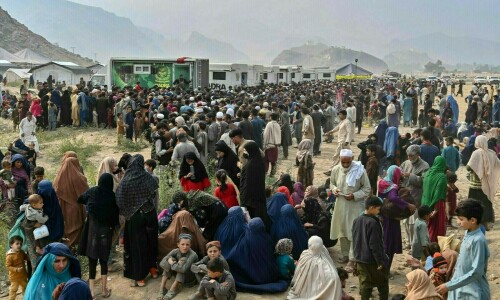
Adding to the pressure, returns from Iran are also increasing due to policy shifts hindering access to legal protection. Between March 20 and April 30, 170,200 Afghans arrived from Iran. The combined returns from Pakistan and Iran, exceeding 300,000 in April alone, are placing “extreme pressure” on Afghanistan’s border regions and urban areas ill-equipped for such large movements, the IFRC concluded.
Published in Dawn, May 26th, 2025