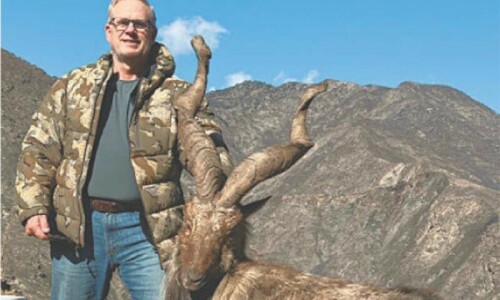
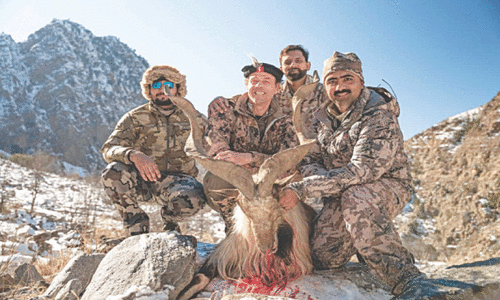
ISLAMABAD: With capacity-building programmes and the engagement of local communities in conservation initiatives, a positive population trend has been observed in the Markhor species, WWF-Pakistan stated on World Markhor Day.
WWF appreciated the conservation efforts of local communities in Gilgit-Baltistan, Khyber Pakhtunkhwa and Balochistan.
According to the organisation, close coordination between conservation organisations, government departments and local communities has resulted in an increase in the Markhor population and their habitat range in Pakistan.
In June 2024, WWF-Pakistan, in collaboration with Pakistan Post, issued stamps showcasing the Kashmir Markhor.
According to WWF-Pakistan, the Markhor species in Pakistan faces numerous threats that jeopardise its survival.
However, the involvement of communities has improved both the habitat and population of the species.
The Markhor, declared the national animal of Pakistan, is a large wild goat species native to South and Central Asia, mainly found in Pakistan, India and parts of Afghanistan.
Since 2015, it has been classified as Near Threatened on the IUCN Red List.
Often categorised based on their horn configuration, Markhors have been divided into five subspecies including Astor Markhor, Bukharan Markhor, Kabul Markhor, Kashmir Markhor and Suleiman Markhor.
Remarking on the day, Hammad Naqi Khan, Director General of WWF-Pakistan, lauded the efforts of local communities in the protection of the Markhor and highlighted the need for transnational conservation efforts to safeguard their future.
He emphasised the need to reaffirm the collective commitment to protect the Markhor and its fragile mountain habitat.
“Conservation is not just about saving a species; it is about preserving our shared future in harmony with nature,” Hammad Khan added.
Markhors are highly adapted to steep, rugged cliffs and dry temperate forests at elevations ranging from 600 to 3,600 meters. As herbivores, they graze on grasses, shrubs and seasonal foliage and play a key role in the health of mountain ecosystems.
Their elusive behaviour and selective foraging patterns also serve as indicators of habitat integrity.
WWF-Pakistan urged that it is time to highlight the ecological value of mountain ecosystems, raise awareness about conservation challenges, and honour community-led efforts that have helped save the Markhor from the brink of extinction.
Published in Dawn, May 25th, 2025