The female body has always been a space of conflict — its ownership, boundaries and rights forever contested. Thus, its representation can scarcely be untethered from its politics within the bounds of a patriarchal system. Yet, a recent two-person show at Karachi’s Canvas Gallery, featuring the works of Misha Japanwala and Zahrah Ehsan, releases the female form from the constraints of commodification and controversy, and presents it as something real and tangible, but elusive at the same time.
Japanwala’s practice is a fusion of fine art and fashion which, according to her, operates on “the notion that our bodies shouldn’t need to prove anything other than being allowed to simply exist.” In this show, she reduces the body to pure form — expressive, provocative, evocative and bold.
The Beghairat Figure Study is a series of gestural line drawings that isolate the body in portions, incorporating the word “beghairat” [shameless], in the Nasta’liq script, within the contours of the female nude. Yet, as the artist says, it reclaims the slur through its unapologetic boldness. What is normally hidden is accentuated, revealing our own biases towards ourselves. We are compelled to confront our insecurities as each curve and fold is celebrated, with a defiance that always stops short of insolence. The work thus embraces the titular term as a badge of honour that frees the body from its implied shame.
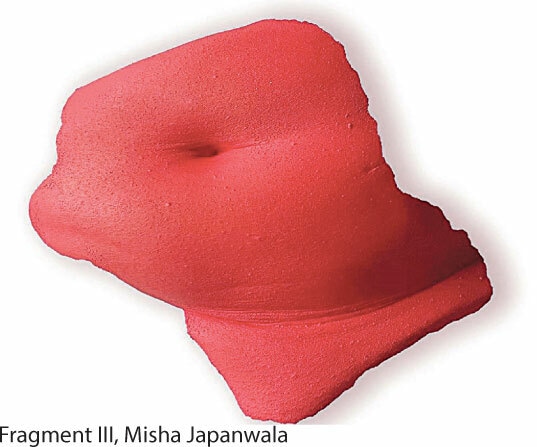
The Fragment series seem to bring these postural studies into three-dimensional form, fragmenting the body into casts of sections created in stark detail, with the bumps, textures and imperfections of the skin that are typically vilified becoming points of beauty. This process removes the figure from its own context to the point of abstraction — de-sexualising, and in turn, de-politicising it. These bodies are not for consumption, but exist as spaces in and of themselves — as real, natural, familiar forms, allowing the viewer to find themselves within them. At the same time, in a paradoxical turn, it is also ruptured and reduced to its sexual parts — crude yet alluring.
Two contemporary artists explore the female body as both space and subject, thus charting a powerful course of reclamation and resistance
This is taken a step further in the Topography series, where the titles take on the names of various land formations, and the form and materials draw parallels between the body and nature. Its provocative folds are suddenly defused, sexual tension neutralised, while still maintaining its fertile beauty, willing us to be kinder to our own perceived faults.
Yet, it is telling that the only way to shed societal expectations from the female body is to, quite literally, remove its humanity, pushing it into the abstract realm. It is symptomatic of deep-seated conditioning in regard to female agency, which a focus on the physical manifestations of womanhood fails to adequately address.
Ehsan’s approach counters this by deriving the metaphorical and metaphysical concept of home from the physicality of the body. For her, the body remains the only constant in an ever-changing background of landscape and geography, a space of comfort and safety.
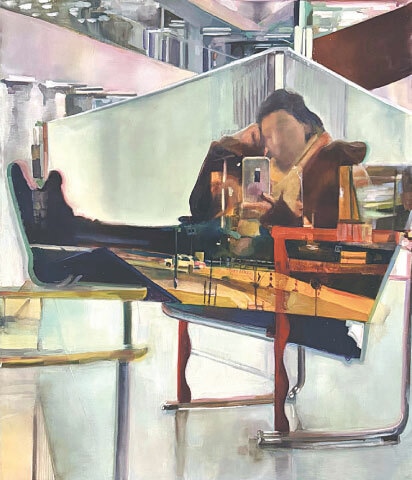
The artist conveys this in drawings and paintings recreated from photographs taken in different locations that are only specified in the titles as the visuals remain generic. The works show her as a presence, the features undefined and blurred, the poses mundane. In the charcoal drawings 9.8.2022 at 14.05, Espoo – Finland I, II, III, the body shifts around the same view of a room, creating a sense of movement.
The oil paintings show lone mirror selfies with casual, relaxed and natural poses. The body is not on display, but self-reflecting in transitory, fleeting moments of stillness, reading like visual diary entries. The spaces around the body become an integral aspect of the narrative. The body carries echoes of experiences and occupied spaces. It is not only a vessel but becomes a carrier of identity, place, culture and stories. Here we see the figure as a complex being, with rich inner worlds rather than a propped object to be seen. In this way, this work more successfully removes sexual connotations from the body, without removing its humanity.
While one fragments and isolates the body from any context, the other situates it in a very specific geographical context. Yet, through these opposing routes, both artists somehow end up at a similar point, of turning the body into space.
However, while Japanwala’s strong visuals hyper-focus on the physicality of the body to take back its agency, it is Ehsan who is more successful in capturing the conceptual depth of women as complex beings, making that physicality irrelevant and truly setting it free.
‘Soft Cartographies’ was on display at Canvas Gallery in Karachi from April 22-May 1, 2025
The writer is an independent art critic and curator
Published in Dawn, EOS, May 25th, 2025