Govt, banks to work on low-cost housing



ISLAMABAD: The government is finalising a plan to introduce a subsidised housing scheme for the lower-income class and mortgage facilities for the middle class with the involvement of commercial banks, starting with government-sponsored 200,000 low-cost housing units.
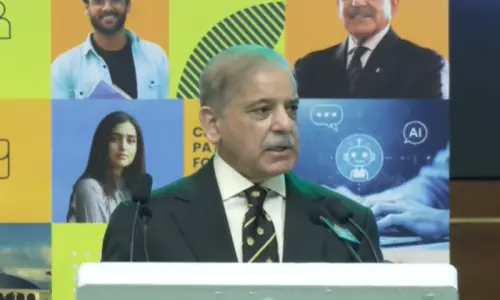
Prime Minister Shehbaz Sharif is expected to formally announce the scheme to revive the housing and construction sector, which is passing through challenging times along with purportedly 72 associated industries, an informed source told Dawn.
The sources said the government would initially provide about 200,000 low-cost 3-5 marla housing units after their construction in the public sector at 50pc subsidy on financing and then expand it. A draft plan was shared with the State Bank of Pakistan (SBP) and commercial banks on Monday.
A meeting on affordable housing finance schemes was presided over by Planning Minister Ahsan Iqbal on Monday to address the critical challenges faced in long-term housing finance and explore viable policy models for low-cost housing in Pakistan. The meeting was also attended by SBP Governor Jameel Ahmed, chief executive officers of private and public sector banks and Pakistan Mortgage Refinance Company (PMRC) representatives.
The SBP chief and commercial bank CEOs sought a week for their feedback. At this stage, the government considered two options. First, provision of 50pc subsidised funding to select people and offer them to construct 3-5 marla houses independently. Second, the government could build such housing units in the public sector and hand them over to people on 50pc subsidised financing. The stakeholders would meet again next week.
The meeting noted that Pakistan currently faces a severe housing shortage and a “paradoxical situation” for affordable housing. The current shortage was estimated at 12 million units, while additional annual demand was around 700,000. In contrast, the annual supply stood at just 250,000. This meant an annual gap of about 450,000 units. This included about 65pc (about 292,500) shortfall in the lower income group, followed by 25pc or 112,500 per annum in the lower middle-income group and the remaining 10pc or 45,000 in the upper middle-income groups.
It was considered paradoxical because there were challenges of affordability, limited access to finance, lack of mortgage financing and 64pc youth below the age of 30 on the demand side. On the other hand, the cost of land and material was too high, there were high risk and low profit margins, regulatory barriers, and high interest and tax rates on the supply side.
The participants reviewed international best practices and mortgage models from countries including Singapore, South Africa, Turkey, Bangladesh, Brazil, and India. They discussed designing a practical and sustainable housing finance framework tailored to Pakistan’s socio-economic landscape.
The minister said that the unavailability of long-term housing finance remained one of the country’s most significant barriers to affordable housing. He recalled substantial progress made in 2017-18, which was unfortunately disrupted by political instability. “When policy continuity is lacking, the public bears the cost,” he noted.
Referring to the success of auto-leasing models in the private sector, the minister questioned why a similar model could not be implemented for housing. “Millions of people live their entire lives in rented homes. Owning a house should not be a distant dream for the salaried class,” he said, adding that “a two to three crore home cannot be built through lump-sum payments by an average income earner.”
Ahsan Iqbal advocated for a housing finance framework similar to auto-leasing, backed by mortgages and supported by government policy.
Published in Dawn, May 13th, 2025