0
0

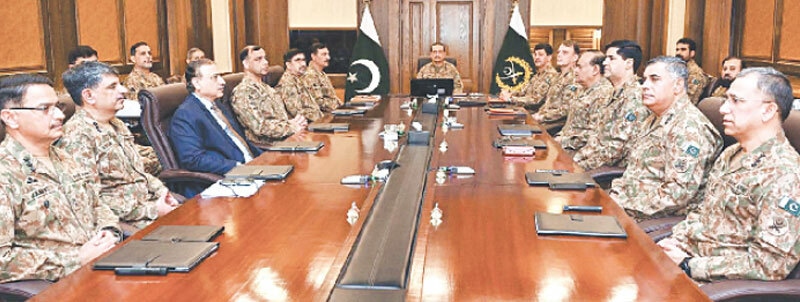
• Vows to defeat India’s deliberate efforts at destabilisation
• Head of SPD, which controls nuclear assets, also attends corps commanders’ conference
• Huddle underscores Pakistan’s intent to stay focused on terror threat from western border
ISLAMABAD: Amid the ongoing standoff with India, the military top brass emphasised the country’s conventional and nuclear deterrence as they signalled a heightened resolve to respond should the red lines be crossed, while the civil leadership intensified diplomatic outreach to ease regional tension.
During his closing remarks at the extraordinary Corps Commanders’ Conference, Chief of Army Staff Gen Asim Munir asserted “complete confidence in the operational readiness, deterrence posture, and morale of all formations and strategic forces to defend the nation across the entire threat spectrum,” according to Inter-Services Public Relations (ISPR).
The meeting took place against the backdrop of heightened regional tensions, after last week’s attack in India-held Kashmir.
India escalated tensions with Pakistan through military and diplomatic actions, accused ‘cross border linkages’ of the attackers, initiated skirmishes along the Line of Control and hinted at potential air strikes.
Diplomatically, New Delhi suspended the Indus Waters Treaty, closed the Wagah-Attari border, expelled Pakistani diplomats, banned Pakistani flights, and revoked visas of Pakistani nationals.
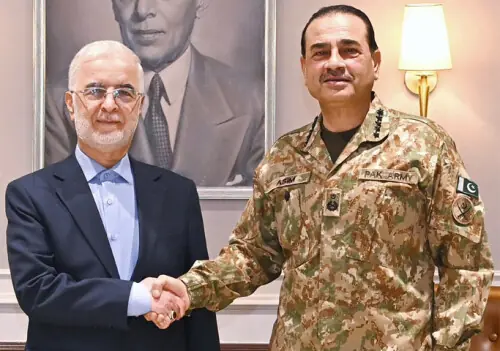
The corps commanders meeting chaired by Gen Munir was physically attended mostly by Rawalpindi-based three-star generals. Director General ISI Lt Gen Asim Malik, who was recently designated as the National Security Adviser, was also present on this occasion.
Most significant was the participation of Lt Gen Yusuf Jamal, who heads the Strategic Plans Division, which serves as the secretariat of the National Command Authority – which controls the nuclear arsenal. The SPD chief does not normally sit in the corps commanders meeting.
In recent days, the military’s messaging has evolved from broad deterrence to more specific references about the nuclear option.
Speaking to troops at Exercise Hammer Strike, Gen Munir stressed military readiness, technological edge, and a “swift, resolute, and notch up response” to any aggression, projecting a generalized posture of strength.
The National Security Committee likewise warned of a “full force” response across the “complete spectrum of national power”.
But the statement issued after Friday’s conference fortified that posture by promising a “sure and decisive” response across the “entire threat spectrum” and COAS expressing confidence in strategic forces — language that subtly invokes Pakistan’s nuclear capabilities alongside its conventional forces.
“The forum reaffirmed the unflinching resolve of the Pakistan Armed Forces to uphold the sovereignty and territorial integrity of the country against any aggression or misadventure,” the ISPR said, noting the army chief’s emphasis on “heightened vigilance and proactive readiness across all fronts” and the pledge to “defend the homeland at all costs”.
The renewed nuclear signalling raises the stakes and underscores the urgency of de-escalation efforts.
Terrorism a bigger challenge
However, the generals also reiterated Pakistan’s commitment to “peace, stability and prosperity,” vowing that the march towards “peace and development will not be deterred by terrorism, coercion or aggression — whether directly or through proxies.”
The ISPR said the corps commanders conference resolved that “deliberate destabilisation efforts by the Indian government will be confronted and defeated with resolve and clarity.”
By underscoring Pakistan’s intent to stay focused on its western border, where it is battling resurgent terrorism, the generals sought to convey a message to the international community that they perceive “terrorism as a bigger challenge”. Therefore, they framed Pahalgam incident, orchestrated by India, as a distraction and Delhi as a spoiler of regional stability.
“In the latest instance, the Pahalgam episode appears to be part of a deliberate strategy to divert Pakistan’s focus away from the western front, as well as ongoing national efforts for economic revival; the two fronts where Pakistan is decisively and sustainably gaining grounds. Such diversionary tactics aimed at providing operational breathing space to Indian terror proxies will never succeed.”
The stronger assertion about Indian sponsorship of terrorism in the CCC statement suggested that the government may be preparing to diplomatically raise the issue at the international stage based on evidence.
“The forum also voiced deep alarm over credible evidence of direct Indian military and intelligence involvement in orchestrating terrorist activities inside Pakistan. These state-sponsored actions are in blatant violation of international norms which are universally unacceptable,” ISPR said.
While referring to Indus Water Treaty suspension as a significant escalation the commanders elevated the crisis to an existential level signalling a red line for Pakistan as they sought to internationalise the issue by highlighting a threat to 240 million people.
The generals recalled the Pulwama episode of 2019 and the revocation of Article370 as historical precedents for India exploiting crises to achieve political and military objectives.
“India is now exploiting the Pahalgam incident to undermine the longstanding Indus Waters Treaty, seeking to usurp Pakistan’s legitimate and inalienable water rights,” the military brass noted, and warned that this would escalate strategic instability in the region.
Published in Dawn, May 3rd, 2025