ISLAMABAD: The government on Thursday announced the exclusion of about 7,960 megawatts of proposed power projects and the rescheduling of 7,000MW of previously committed plants from the revised 10-year Integrated Generation Capacity Expansion Plan (IGCEP) 2025-34, projecting total savings of Rs4.743 trillion ($17 billion) over their operational lifespan.
Based on a review of existing project pipeline, Prime Minister Shehbaz Sharif has approved the revised IGCEP 2025-34 for submission to the National Electric Power Regulatory Authority (Nepra) for formal approval. The revised plan meant an investment of $47.4bn over the next 10 years instead of $64.3bn previously planned by the power division.
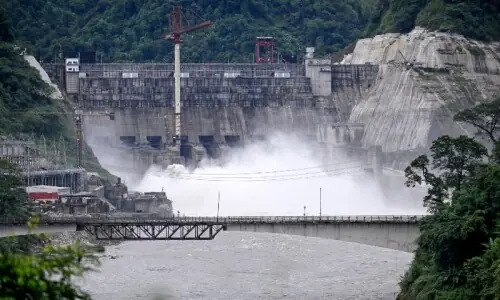
The prime minister also directed the completion of Diamer-Bhasha Dam on a priority basis to ensure effective irrigation system and power generation.
Power Minister Sardar Awais Leghari said that out of the previously planned 15,000MW capacity additions, about 7,000MW would have resulted in expensive power and are being scrapped.
Expects savings of Rs4.7tr by rescheduling 7,000MW of already committed plants
The prime minister was told that “around $10bn (about Rs2.790tr) was saved by adjusting the timelines of committed capacity under the IGCEP (submitted to Nepra). An additional $7bn (Rs1.96tr) in savings resulted from rationalising the committed capacity portfolio”.
Mr Leghari said the government had also decided that the government would not purchase generation capacity in future; instead, capacity addition would be based on a competitive market. He said the government was now pulling out of the single-buyer system and no capacity addition would be allowed on cost-plus tariff.
He said the future governments would be bound to follow the principle of competitive electricity market and would not be able to contract expensive electricity.
The government submitted IGCEP 2024-34 to Nepra in April 2024 for approval which came under significant scrutiny due to emerging sectoral dynamics like declining electricity demand, a rising share of net metering, and the presence of a large volume of committed capacity additions.
“These developments raised concerns over the potential burden on end consumers if the committed projects were approved without re-evaluation”, the power minister said.
The IGCEP-2024-34 involved a total of 25,973MW of new capacity additions, of which 25,573MW (98.5pc) was categorised as committed capacity, leaving only 400MW (1.5pc) as candidate capacity subject to optimisation.
The Net Present Value (NPV) of this proposed plan stood at $64.30bn, including $42.61bn in fixed costs and $21.69bn in generation costs.
Given the high reliance on committed projects and reduced demand projections, a detailed review of the committed project criteria was undertaken. Considering the assumptions and policy provisions, the IGCEP draft submitted to Nepra was thoroughly assessed, wherein 73 projects were initially classified as committed in the draft IGCEP-2021-31.
These projects were facilitated by various project executing agencies at the federal, provincial, AJK and Wapda levels with a collective capacity of 22,418MW. By the end of 2024, 7,434MW of this capacity had been commissioned.
The remaining capacity within the committed category stood at 14,984MW, which came under subsequent review based on the basic principle of financial closure achieved in the private sector or financial commitment in the public sector along with more than 10pc of construction and financial progress.
Based on revised criteria, only 7,017MW out of the initial 14,984MW qualified to remain in the committed category. The remaining projects were subsequently evaluated under the least-cost optimisation framework within the IGCEP.
“Based on the refined categorisation of committed projects, the system achieved savings of Rs1.015tr relative to the business-as-usual case with forced capacity additions,” the power minister said.
Published in Dawn, May 2nd, 2025