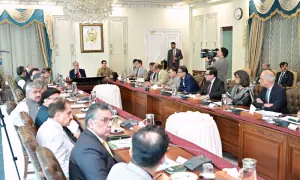
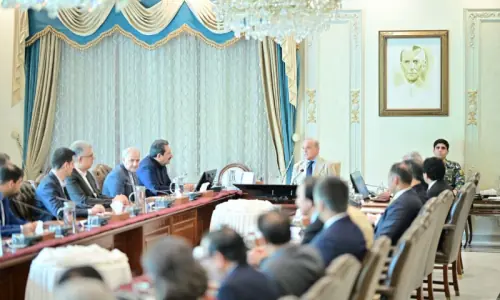
LAHORE: Experts at a two-day conference on the management of Pakistan’s economy organized by the Lahore School of Economics (LSE) have called urbanization a key to country’s economic growth and urged the government to focus on this. The event focused on challenges to growth and trade, against the backdrop of a sluggish economy, rising debt and the country’s 24th IMF programme.
Pakistan’s GDP is expected to grow by just 2.2 per cent in the current fiscal year (FY2025), a weak recovery after stagnation over the past two years. Trade deficits continue to widen, and the economy remains dependent on worker remittances and frequent IMF support.
Dr Mathew McCartney from the African School of Economics (Zanzibar) spoke about the absence of urbanisation in Pakistan’s macroeconomic planning. “Urbanisation, when managed well, connects workers, firms and markets — improving productivity, exports and industrialisation,” he said. He added that Pakistan’s urbanisation rate remains lower than what’s expected from a middle-income country, dragging down industrial progress and technical innovation.
“I urge policymakers to move beyond crisis management and instead leverage cities for productivity and export growth,” he said.
Former State Bank governor Dr Ishrat Hussain praised LSE’s economic model and its research-based policy work. He noted that any progress would require long-term thinking — a sentiment echoed by other participants.
LSE Rector Dr Shahid Amjad Chaudhry warned about the dangers posed by Pakistan’s external debt, which has reached $130 billion, or 23% of GDP. “Up to $12bn of this debt needs to be rolled over each year that is a serious risk,” he said. He added that the additional $3 billion expected in annual remittances over the next few years be used to retire this short-term debt gradually, reducing future vulnerability.
Economists Dr Moazam Mahmood and Dr Azam Chaudhry presented growth estimates for FY2025, with GDP growth projected at just 2.2pc. Inflation, though eased to 10pc, has been managed through an unusual policy mix — steep increases in energy prices and halving of wheat prices.
Dr Rashid Amjad traced the economy’s recurring boom-bust cycles. While supporting structural reforms under the IMF’s Extended Fund Facility, he warned that these often lack the incentive structure needed to lift investment, currently stuck at just 9 percent of GDP — locking Pakistan in a low-growth trap.
Statistical evidence presented by Dr Gul Andaman revealed that economic growth beyond 3.7 per cent of GDP leads to unsustainable trade deficits due to high import demand. He identified three key factors limiting sustainable growth: the income elasticity of imports, growth in remittances, and the real effective exchange rate.
Dr Naved Hamid and Dr Murtaza Syed echoed this concern, arguing that weak productivity has lowered the GDP growth rate that the current account can support from 5 percent to just 4pc.
International perspectives were brought in by Dr Rajah Rasiah from the University of Malaya, who drew on his research on industrial policy in Southeast Asia. He recommended a pro-active industrial policy to revive Pakistan’s manufacturing sector, urging learning from ASEAN models.
Other sessions focused on sector-specific challenges. Natasha Moeen, Dr Mehreen Khan, and Dr Theresa Chaudhry examined how to tackle Punjab’s air pollution caused by transport, linking environmental damage to public health.
Dr Rabia Arif presented findings showing that exports tied to Global Value Chains (GVCs) have a stronger impact on GDP than those outside GVCs. Dr Waqar Wadho emphasised that international certifications significantly improve a firm’s product diversification and export performance.
A team from the State Bank of Pakistan — Dr Kaleem Hyder, Sabina Khurram Jafri and Omar Farooq Saqib — discussed the inflation surge that began with the COVID-19 pandemic and continues to strain household budgets.
Dr Mujtaba Piracha and Usman Khan evaluated the performance of the Export Development Fund, while another session by Shamyla Chaudry, Dr Moazam Mahmood and Muzzna Maqsood examined Pakistan’s persistently low savings rate, which remains a major obstacle to investment. Dr Arshad Hassan, Dr Jamshed Uppal, Dr Zunia Saif, Ali Khilji, Dr Naseem Faraz and Ahmed Fasih also spoke.
Published in Dawn, April 26th, 2025