Glofs slowly turning Swat’s alpine Utror, Gabral valleys into ‘zones of despair’
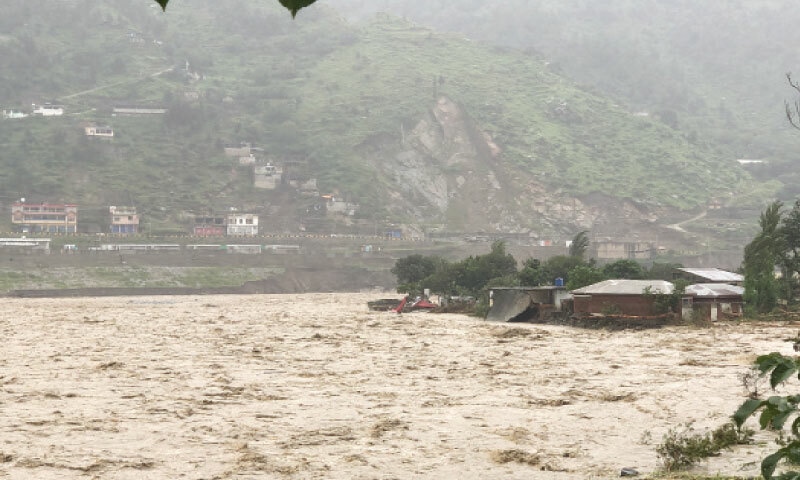

SWAT: Nestled in the majestic Hindukush mountains, the alpine valleys of Utror and Gabral in upper Swat are renowned for their terraced fields, off-season vegetables, walnut orchards, and vibrant cultural traditions.
However, over the past decade, glacial lake outburst floods (Glofs) caused by melting glaciers have turned these once-idyllic landscapes into zones of despair. As climate change intensifies, residents are being forced to abandon their ancestral homes, leaving behind not only buried farmland and shattered infrastructure but also a fading cultural legacy.
Rising global temperatures have accelerated the retreat of glaciers in northern Pakistan, leading to the formation of unstable glacial lakes. When these lakes breach their natural barriers, they unleash torrents of water, rocks, and debris. In Utror and Gabral, recurring Glofs since 2010 have washed away centuries-old agricultural terraces, apple orchards, and crucial bridges – cutting off access to schools, hospitals, and markets.
“Our land was our life. The floods took everything – our wheat, our fruit trees, even the soil,” said Ahmed Khan, 58, a farmer from Gabral. “The river swallowed my field in minutes. Now, there’s only rock and mud where my children once played.”
Recurring floods since 2010 washed away agricultural fields, apple orchards and bridges
Local authorities estimate that over 300 families have vacated upper Swat in the past five years alone, with many more expected to follow as Glofs increase in frequency and severity.
With no arable land remaining, displaced families have migrated to urban centres in Punjab such as Rawalpindi, and to the plains of Khyber Pakhtunkhwa, in search of daily wage labour. For many, the transition has been jarring.
“In Swat, we lived off our crops. Here, I work 12 hours a day as a construction labourer just to feed my family,” said Iqbal, who relocated to Mardan in 2021. “We lost our home, our community. But what choice do we have?”
The migration has also triggered a silent cultural crisis. Uprooted children, now growing up in Punjabi or Pashtun-majority areas, are becoming increasingly disconnected from their native Kalami dialect – a Dardic language unique to upper Swat – as well as traditional attire such as woollen shalwar kameez and indigenous festivities.
“My grandchildren speak only Pashto and Urdu. They laugh when I sing Kalami lullabies,” lamented Gul Sanam, 67, a storyteller from Utror. “Our history is vanishing with each generation.”
Mohammad Zaman Sagar, a linguist at the University of Peshawar, warns that this displacement threatens to erase traditions dating back millennia. “Kalami is spoken by fewer than 10,000 people globally. When communities are scattered, their language and oral histories disappear,” he said. “These climate refugees aren’t just losing homes – they’re losing their identity.”
Schools in migrant settlements rarely teach about Kohistani cultures, and cultural practices are gradually diluted as youth assimilate. “I cannot wear my local dresses to college here. Everyone else dresses differently,” admitted Arifullah, 16, who moved to Swabi in 2020.
While the KP government has pledged to construct Glof-resilient infrastructure, progress remains slow. Activists are calling for urgent climate adaptation strategies, such as early warning systems and reforestation, alongside initiatives to preserve cultural heritage.
“Climate change isn’t merely an environmental issue – it’s a war on our heritage,” said Zubair Torwali, a linguist and social activist based in Bahrain.
“If we do not act, future generations will only know upper Swat through forgotten stories.”
For now, the valleys grow quieter each year, their people and traditions scattered across Pakistan’s plains – a stark reminder of the human cost of a warming world.
Published in Dawn, April 16th, 2025