As the United States and China wage an all-out trade war — with escalating tariffs, strategic retaliations, and an economic standoff that reverberates globally — the impact on Pakistan is both profound and potentially existential.
For a nation burdened by a fragile economy, geopolitical dilemmas, and longstanding structural inefficiencies, these global shifts introduce challenges that are far more than mere collateral damage; they portend a future where Pakistan’s economic relevance may be at serious risk.
Pakistan’s economy has long struggled with inherent weaknesses: fragile fiscal management, a persistently volatile currency, and underdeveloped industrial sectors. In an era when global supply chains are increasingly disrupted by tariff escalations, Pakistan’s position is particularly precarious.
Global realignments in trade routes and the redirection of export surpluses are likely to place mounting pressure on emerging markets. As China’s surplus begins to flood regional markets at aggressively competitive rates, Pakistani exporters — particularly within low-margin sectors such as textiles — now confront the dual challenges of declining competitiveness and a shrinking share of markets that were once traditional strongholds.
Without a marked improvement in economic governance, Pakistan risks being sidelined in favour of economies with more competitive advantages
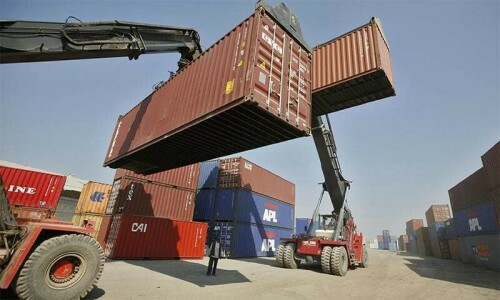
With energy costs remaining stubbornly high and infrastructure bottlenecks continuing to plague domestic industries, Pakistan will face heightened volatility in shipping contracts and global commodity prices.
Importers are likely to face soaring costs for critical inputs — ranging from industrial machinery and chemicals to essential food items. In an economy where inflation has proven historically endemic, these shocks are likely to directly erode household incomes and overall economic stability.
The complex interplay of domestic instability and an unpredictable global trade environment will lead foreign investors to reassess their risk exposure. Political uncertainties and an unpredictable policy framework have already dampened investor confidence. Global capital markets prize certainty, and without a marked improvement in economic governance, Pakistan risks being sidelined in favour of economies with more competitive advantages.
Traditional industrial hubs — cities like Faisalabad and Sialkot — continue to face severe challenges. Here, local industries wrestle with high operating costs, persistent infrastructural inefficiencies, and fierce international competition. The intensified influx of discounted Chinese imports will further hurt the local industries.
As deep-pocketed Chinese manufacturers capture an ever-increasing share of export orders, the resultant diversion of business is likely to lead to thinning profit margins and diminishing returns. This scenario threatens to translate into significant job losses in sectors that have historically formed the backbone of Pakistan’s manufacturing output.
As global trade maps are redrawn in favour of nations boasting streamlined processes, robust legal systems, and competitive infrastructures, Pakistan’s ability to adapt remains in question. The recent aggressive diplomacy by countries such as Vietnam and Bangladesh underscores the risk that Pakistan, if it fails to reform, will find itself further marginalised from key export markets.
To mitigate these risks and reposition itself on the global stage, Pakistan must embark on deep and swift structural reforms. Pakistan must re-engineer its trade and industrial strategy by investing in the efficiency of its supply chains and embracing the digitalisation of export procedures.
Crucially, upgrading port facilities, ensuring a dependable power supply, and streamlining bureaucratic procedures remain high on the reform agenda. Government officials are already discussing such measures to attract foreign direct investment.
Overreliance on textiles and other low-margin products has rendered Pakistan vulnerable. Policy debate and recent government statements indicate a new focus on diversifying exports. Sectors such as pharmaceuticals, information technology services, and light manufacturing are being earmarked for rapid development through dedicated incentives, enhanced access to financing, and long-term policy certainty.
Caught between strong economic ties to China — exemplified by flagship initiatives such as the China-Pakistan Economic Corridor (CPEC) — and its ongoing reliance on Western financial institutions for bailouts, Pakistan’s diplomatic ambiguity is proving costly.
Contemporary diplomatic analyses suggest Islamabad must now clarify its global economic identity by embracing an independent and data-driven trade policy, rather than oscillating between superpower allegiances.
Beyond physical infrastructural improvements, Pakistan needs to bolster the quality and productivity of its manufacturing and service sectors. Establishing robust legal and regulatory frameworks, particularly for contract enforcement and intellectual property rights, is essential to creating an environment conducive to sustainable economic growth and international investment.
The US-China trade war is not an isolated geopolitical squabble; its effects are real, immediate, and far-reaching for Pakistan’s economic future. Facing a once-in-a-generation challenge, Islamabad now stands at a crossroads. The choices are stark: persist with current ad hoc, crisis-driven management or commit to comprehensive, strategically reformed policies that not only strengthen domestic industries and diversify exports but also define a clear and independent global economic strategy.
Embracing radical reform — though politically and economically challenging — may be Pakistan’s only viable route to not just survive, but to forge a thriving position in a rapidly evolving global order or disorder. Without such fundamental changes, the nation risks sliding into economic stagnation and a continued decline in its international stature.
The writer is former head of Citigroup’s emerging markets investments and author of ‘The Gathering Storm’
Published in Dawn, The Business and Finance Weekly, April 14th, 2025