Billions will suffer if rapid glacial melt continues: report
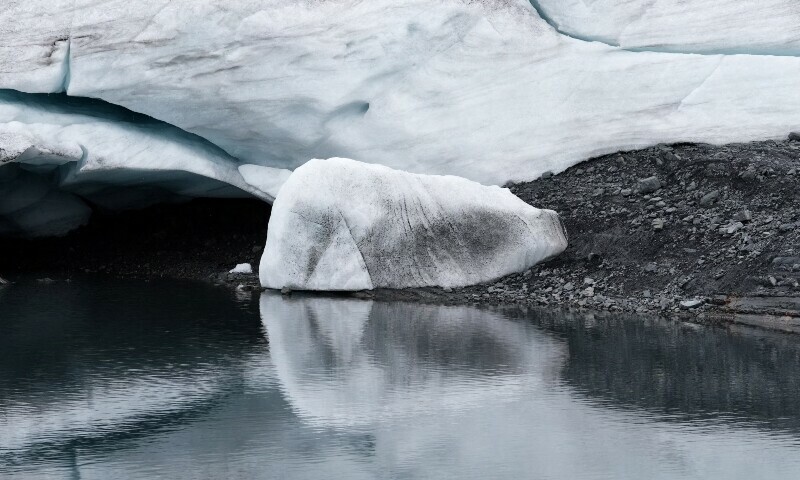


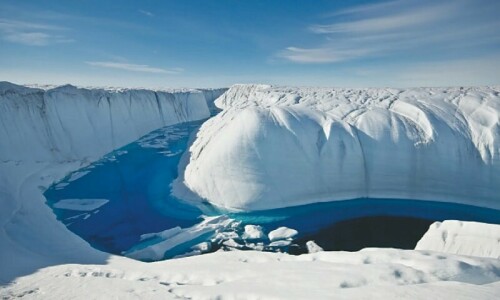
ISLAMABAD: A new UN report has warned that rapidly melting glaciers and snow have imperilled the global ecosystem and billions of people who rely on freshwater from these sources.
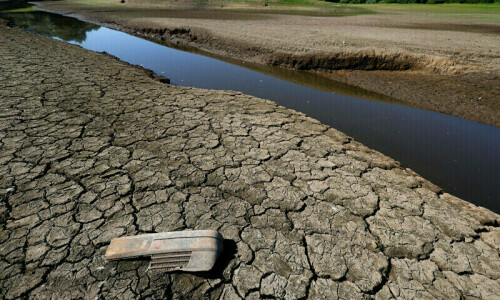
The World Water Development Report 2025, released by Unesco to mark ‘World Water Day’ on March 22, said 25 countries, home to one-quarter of the world’s population, face extremely high water stress every year.
About four billion people, or half of the world’s population, experience severe water scarcity for at least part of the year.
The report said glaciers were at extreme risk due to global warming, pollution, and unsustainable human activities, and if not properly managed, they could become a source of perpetual conflicts.
Unesco report says Hindu Kush, Himalaya could lose 50pc of glaciers by year 2100; calls for novel solutions to avert disaster
While highlighting the depleting freshwater sources, the report highlighted the Andes mountain range, which supplies 50 per cent of the water flowing into the Amazon River, has lost between 30pc and 50pc of its glaciers since the 1980s.
It is projected that Mount Kenya, Rwenzori and Kilimanjaro glaciers will have disappeared entirely by 2040 if no action is taken, while the ‘Third Pole’ — also known as the Hindu Kush–Karakoram–Himalayan system — could lose 50pc of its glacier volume by the year 2100.
Particularly in the Asia–Pacific region, alpine glaciers were “disappearing at an alarming rate, often faster than the global average”.
Over the long term, reduced water flows and increased droughts are expected to jeopardise food, water, energy and livelihood security in the Hindu Kush-Himalaya region, the Unesco report warned.
The region — which stores more ice and snow than any other region outside the Antarctic and Arctic — is the origin of more than ten river systems that are vital for sustaining nearly two billion people.
Threats
The report added that as per recent estimates from 2021, the agriculture sector withdrew the most water (72pc), followed by industry (15pc) and domestic use (13pc). However, this reliance on water is threatened by climate change, which is “increasing seasonal variability and uncertainty about water availability in most regions”.
“Pollution, land and ecosystem degradation, and natural hazards can further compromise the availability of water resources.”
The report added that mountain regions globally were receiving more emissions due to wildfires and dust storms.
These, along with human activities, were leading to the growing deposition of black carbon and other particulate matter on glacier surfaces.
“The impurities darken snow and ice surfaces, thus causing greater absorption of solar radiation,” the report said while explaining the rapid melting of glaciers.
If no action is taken, the report said water flows from mountains will become more erratic, uncertain, and variable.
These risks come with a number of other associated threats like debris flows and floods, avalanches, rock- and icefalls, landslide dam outburst floods and glacial lake outburst floods that can pose significant threats to communities, wildlife and infrastructure.
Solutions
The report emphasised that glacial melt and water-related crises must be addressed by strengthened adaptation measures, integrated water resources management (IWRM) and solutions for climate, nature and pollution, supported by regional collaboration.
It added that integrated solutions that increase the region’s adaptive capacity and resilience were vital for preserving glaciers.
The establishment of the World Meteorological Organization’s Third Pole Regional Climate Centre Network (TPRCC-Network) was a key development in this regard.
The report said that water-related crises should be prominently focused in climate adaptation plans in the mountain areas of Asia and the Pacific, with joint adaptation strategies developed across national and administrative boundaries to address the issue.
The report recommended decentralised water and sanitation systems that can be effective in mountain regions as they would reduce the risk of infrastructure damage in landslide-prone areas.
The Unesco report called for “engagement and meaningful collaboration” with Indigenous Peoples and local communities.
“[The] willingness to learn from stewardship of water systems evolved over generations will improve the collective ability to respond to changing mountain cryospheric and downstream hydrological conditions.”
The report added that climate adaptation finance and contributions by the private sector were vital for adaptation strategies in the mountains.
“More specifically, innovative and affordable international, regional, national and local funds should be mobilised to support water, agriculture and energy planning and infrastructure investments,” it concluded.
Published in Dawn, March 22nd, 2025