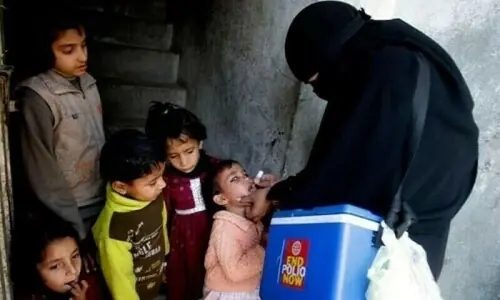
KARACHI: A local study recently published in an international journal highlights how community-driven incentives in rural areas can significantly increase breastfeeding, immunisation, and oral rehydration rates — three critical factors directly linked to child mortality in Pakistan.
Published in The Lancet Global Health, the study was conducted by researchers from Aga Khan University’s Institute for Global Health and Development (IGHD).
It presents a transformative model for addressing preventable illnesses such as childhood diarrhea and pneumonia, which remain leading causes of death among children under five in the country.
The study examined the impact of two interventions: community mobilisation alone and mobilisation combined with collective, conditional, non-cash incentives. It involved 48 clusters across Tando Muhammad Khan in Sindh.
The findings revealed significant improvements in child health indicators in incentivised communities. Compared to the control groups, these improvements included an 80 per cent higher breastfeeding rate, a 50pc increase in the use of oral rehydration treatments, a 30pc improvement in cleanliness habits and a 30pc higher immunisation rate.
Dr Jai K. Das, assistant director at IGHD and lead author of the study, explained: “The study shows that when communities are actively engaged, empowered and take charge of setting their own priorities, it leads to extraordinary results. The ability to choose non-cash rewards, such as water pumps or sanitation facilities, fostered a sense of ownership and accountability, driving sustainable behavioural changes.”
In Pakistan, the poorest populations are disproportionately affected by substantial discrepancies in access to essential health services. Less than one-third of rural households have access to adequate sanitation, while the nation’s immunisation rate remains at 66pc.
The study’s innovative approach — conditional, collective, community-based incentives — not only improved health behaviours but also encouraged communities to co-invest in long-term solutions.
The findings showed that communities are more likely to invest when they are empowered to decide on incentives. This was evident from the fact that contributions — including labor, land and supplies — resulted in a cost-sharing rate 36pc above the 25pc target.
In addition to promoting sustainability and ownership, these community-driven incentives also had multiple positive effects, such as better health outcomes, increased community well-being and improved sanitation.
Dr Zulfiqar A. Bhutta, founding director of IGHD, emphasised the broader implications of the trial: “This trial demonstrates the potential of community-driven solutions in achieving scalable health improvements. It is a model that can be adapted in other low- and middle-income countries to address inequities and save lives.”
Dr Jai K. Das further highlighted the model’s broader applicability, stating: “For a country like Pakistan, this approach could also be tested for other health challenges, such as malnutrition and polio vaccine hesitancy. Additionally, this strategy ensures transparency in fund utilisation at the micro level, making it a viable option for broader adoption.”
Published in Dawn, March 11th, 2025