Over 130 killed in Syria as Assad loyalists take on pro-government forces
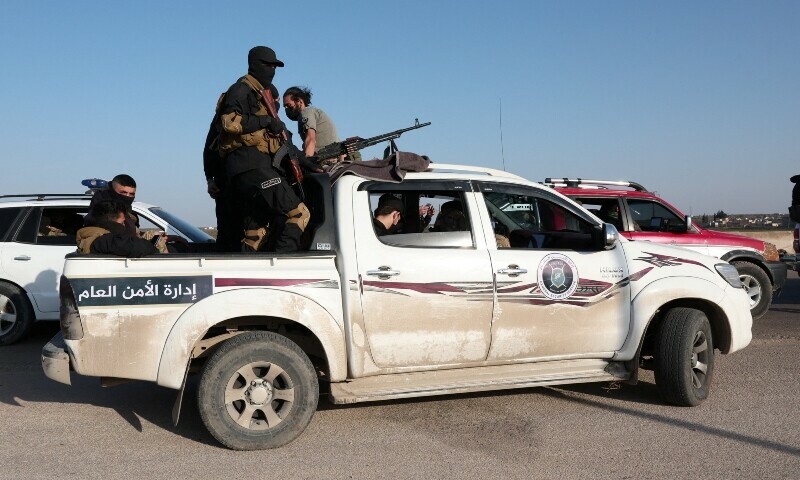


DAMASCUS: More than 130 people were killed as Syrian forces battled for a second day on Friday to crush a nascent insurgency by fighters from former ruler Bashar Al Assad’s Alawi sect.
The coastal region of Latakia, heavily populated by the pro-Assad Alawi minority, has seen heavy fighting over the last three days.
Syrian authorities said the violence began when remnants loyal to ousted leader Assad launched a deadly and well-planned attack on their forces.
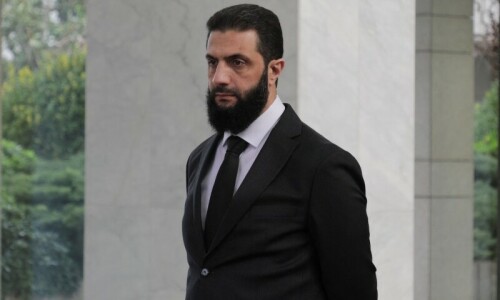
The violence has shaken interim President Ahmed Al Sharaa’s efforts to consolidate control as his administration struggles to get US sanctions lifted and grapples with wider security challenges, notably in the southwest, where Israel has said it will prevent Damascus from deploying forces.
Syrians took to the streets to rally in support of the government in Damascus and other cities, while Saudi Arabia and Turkiye, both allies of the government, also signalled their backing.
Russia, which was a major backer of Assad but has sought to build ties with the new government, said it was alarmed by a deterioration in the security situation and called on all “respected” leaders of the country to stop the bloodshed.
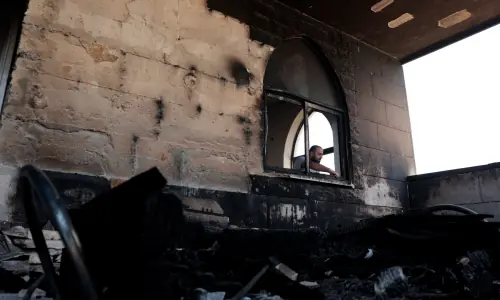
Images from Al Mukhtareyah, in Latakia province, showed 20 men lying in close proximity — some bloodied — by the side of a road in the town centre. Alawi activists said the killings were on Friday and blamed them on gunmen affiliated with the ruling authorities.
A government spokesperson and two officials linked to the ruling authority did not respond to requests for comment.
A prominent Alawi cleric, Sheikh Shabaan Mansour, 86, was killed on Friday with his son in the village of Sahlab in western Syria. Residents accused fighters aligned with Damascus of killing him.
Curfews
Syrian state news agency SANA, citing a security source, said “individual violations” had been perpetrated after unorganised crowds had headed to the coastal region following the attacks on government security personnel.
The violence spiralled on Thursday when the authorities said groups of Assad-aligned militias targeted security patrols and checkpoints in the Jableh area and surrounding countryside, before spreading more widely.
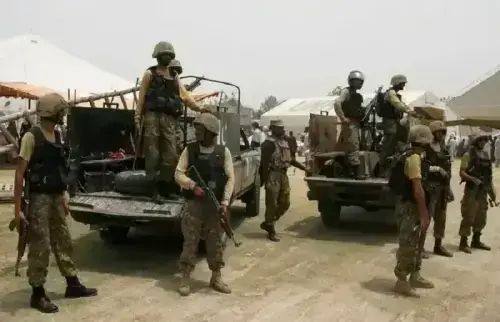
Curfews were declared on Friday in the coastal cities of Tartous and Latakia. Security forces mounted combing operations in both cities and nearby mountains.
Alawi activists say their community has been subjected to violence and attacks, particularly in rural Homs and Latakia, since Assad was overthrown in December after decades of repressive family rule and civil war.
While Sharaa has pledged to run Syria in an inclusive way, no meetings have been declared between him and senior Alawi figures, in contrast to members of other minority groups.
Escalation risk
The Assad-led government recruited heavily from the Alawi community for the security apparatus and bureaucracy of the Syrian state.
While Sharaa has brought much of Syria under the sway of Damascus, important areas remain outside its grasp, including the northeast and east which are controlled by the Kurdish-led Syrian Democratic Forces.
“The chaos and paroxysm of killings will undermine the confidence of both foreign states and Syrians in his government and its ability to steer Syria out of this difficult phase,” said Joshua Landis, head of the Center for Middle East Studies at the University of Oklahoma.
A group Of Alawi clerics, the Alawi Islamic Council, blamed the violence on the government, saying fighters had been sent to the coast “with the pretext of (combating) `regime remnants;’, to terrorise and kill Syrians”.
Published in Dawn, March 8th, 2025