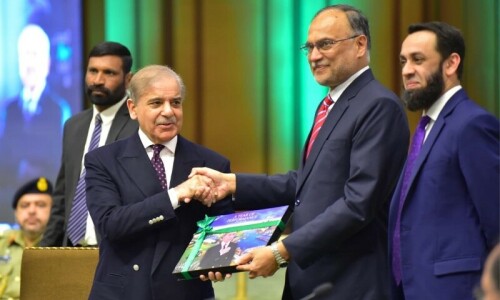
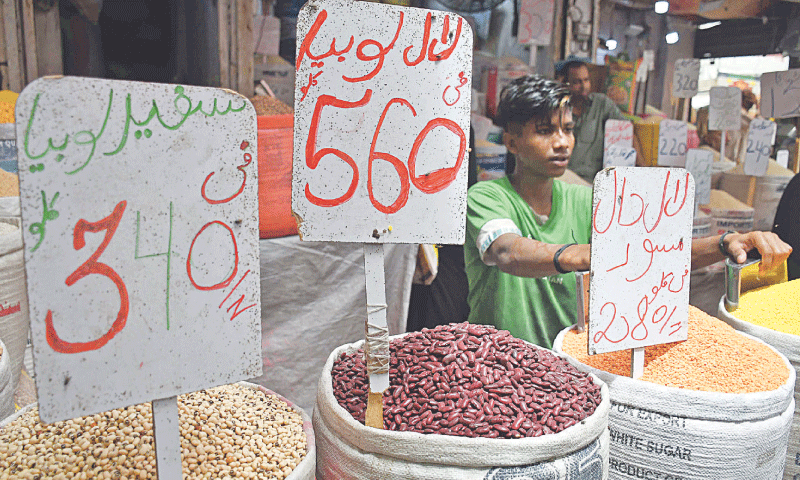
PRIME Minister Shehbaz Sharif recently celebrated his government’s one-year performance scorecard as a testament to its success in “steering the country out of multiple crises”. He spoke glowingly on the macroeconomic stabilisation achieved thus far, which has been made possible with the help of a bailout package from the IMF, assistance from friendly countries, and sharp adjustments in the domestic market which, though they have inflicted unbearable pain on ordinary citizens, have also helped tame runaway inflation.
Mr Sharif’s exuberance may be excused — the present government faced extremely daunting challenges from the get-go, and it deserves to give itself a pat on the back. Admittedly, a more hard-nosed assessment of what the country has gained and lost over the past year may yield more sobering reflections, but as far as political statements go, this one, at least, wasn’t completely full of hot air. It is hoped, however, that it hasn’t made Islamabad lose sight of its bigger goals.
As an opinion published recently in these pages warned, what comes next should be giving the PM sleepless nights. The macroeconomic stability he has been extolling will start seeming meaningless as pressures build to show economic growth. Ordinary people have seen their purchasing power decimated over the past three years, and now that prices seem to be stabilising, they will soon start expecting a return to their old standards of living.
Once that pressure takes hold, this government’s survival will depend heavily on managing public expectations and delivering a path to prosperity that can avoid the pitfalls of past models to engineer growth. This, by no means, will be an easy task, especially if one factors in the seismic changes expected in international finance as the US’s priorities turn increasingly inward, as well as the festering socio-political instability at home.
On the latter, it should be noted that where the government has achieved success in achieving macroeconomic stability, it has failed to improve social conditions or address political instability. The model it has chosen to respond to various existential challenges — use of overt and excessive power — will prove counterproductive once it starts needing public support during the critical transition from stability to growth.
It is well understood that the economy cannot improve till public sentiment improves, and public sentiment cannot improve if the state continues to act against public wishes. This, of course, is an entirely self-inflicted limitation and one which now requires some difficult measures to remove. However, there are no other options but to take the rocky road. Socio-political stabilisation should now be the government’s top priority. Otherwise, the fruits of its labour will not reach the masses, and the immense political price it has paid for stability will have been for nothing.
Published in Dawn, March 6th, 2025