New party envisions establishing ‘second republic’ in Bangladesh


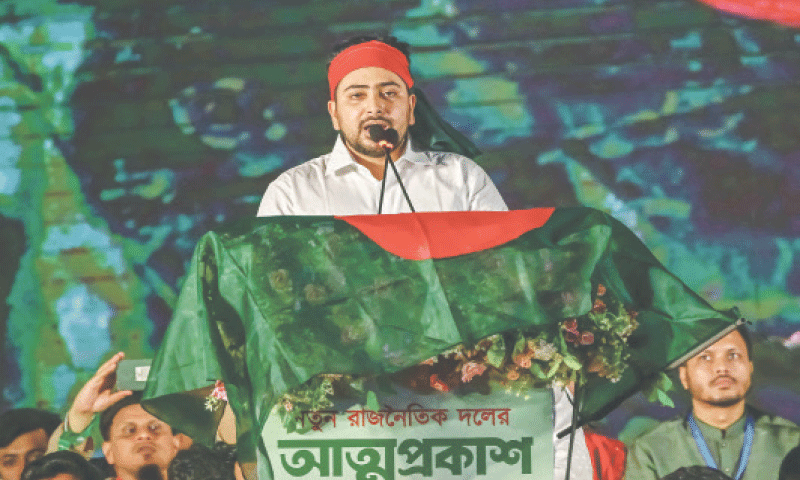
IN its first statement to the people, the National Citizen Party clearly declared a vision for a second republic in Bangladesh. Speaking at the party’s inauguration, Nahid Islam, the top leader of the party read out the declaration which outlines the ideals and principles of his centrist party. But what is this second republic? Second republic signifies transformation of the political system through democratic means, rewriting or reform of constitution and political institutions following a revolution or mass uprising.
The term “second republic” has been used in various countries to refer to a specific period in their political history, usually marking a transition from one form of political system or government to another, said political analysts, in their instant reaction regarding the new political party’s call.
The new party led by July uprising leaders also envisions a constituent assembly. A professor of government and politics at Jahangirnagar University, Al Masud Hasanuzzaman, said the second republic indicates a revolution and the transformation of the political system through democratic means.
“It speaks of correcting the failures of the first republic through reformation and a new constitution, indicating a change in the political system and the entire political settlement,” he said.
Transformation of political system through democratic means, rewriting or reform of constitution and political institutions is the need of the hour
Dhaka University political science teacher Sabbir Ahmed said the leaders of the new party perceive that although the people had established ownership of the state through the independence of 1971, they had lost it afterwards.
“The people regained their ownership through the mass uprising of 2024, and therefore they now want to declare a second republic,” he said attempting to explain the new party’s vision.
“The second republic brings about fundamental changes in the state, the political system, and institutions. The constitution can be rewritten or formed anew and political institutions can be reconstituted or reformed as well,” he added.
Asked about constituent assembly, Al Masud Hasanuzzaman explained that it is elected for the sole purpose of writing a new constitution.
Two ‘second republics’
The first French republic (1848–1852) after the French Revolution had given way to monarchy. The second French republic was established through the revolution of 1848 toppling the monarchy of King Louis-Philippe.
The liberal hopes of establishing an enduring democratic regime were soon frustrated. In 1848 Louis-Napoleon (a nephew of Napoleon Bonaparte) was elected president with a monarchist majority in the legislative assembly. This led to the enactment of conservative measures restricting voting rights and freedom of the press, giving the church increased control over education.
Soon realising that his power and future reelection were limited by the assembly’s actions, Louis-Napoleon organised a coup d’etat in 1851. Following a new constitution that reduced the assembly’s power, and a plebiscite, Louis-Napoléon declared himself emperor Napoléon III in 1852 Louis-Napoleon, and thus the second empire was born.
France has so far had five republics with the last one founded in 1958.
Second Republic of Spain (1931–1939) emerged as King Alfonso XIII was forced to leave Spain after municipal elections showed massive support for republicanism. It led to the introduction of secular reforms, including separation of church and state. The Spanish Civil War (1936–1939) led to collapse of Second republic and Francisco Franco established a dictatorship that lasted until 1975.—The Daily Star/ANN
Published in Dawn, March 3rd, 2025