Buttler proves great players are not always the best captains
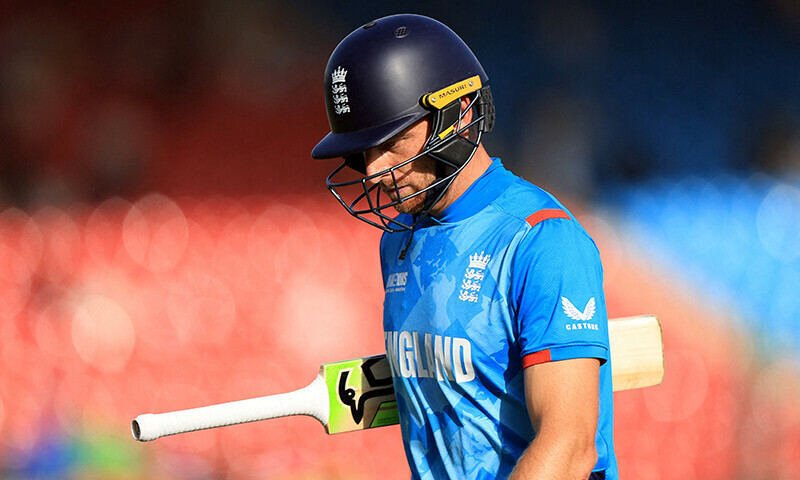


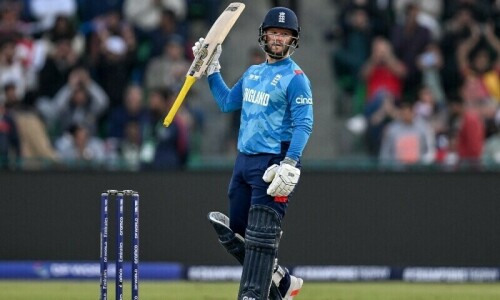
LONDON: Jos Buttler made an unceremonious exit as England’s white-ball captain on Friday, endorsing the popular perception that great players do not always make great captains.
Buttler is arguably England’s greatest white-ball batter and was tipped to scale similar heights as skipper after he led the side to the T20 World Cup title in Australia in 2022.
Since then, England have instead made a steady decline.
In the last 16 months, England have failed to defend either of their World Cup titles and on Wednesday were sent packing from the ICC Champions Trophy by Afghanistan.
As the captain of England’s short-format teams, Buttler compiled a win-loss record of 18-15 in One-day Internationals and 26-22 in Twenty20 Internationals.
The 34-year-old joins India’s Sachin Tendulkar and West Indian Brian Lara as players who failed to translate their many individual triumphs into success as captains.
Despite being blessed with outrageous talent, those two greats of the game lacked the tactical acumen to outsmart their rivals and the man-management skills to get the best out of their team mates.
Former England captain Mike Brearley is often cited as a captain who got the best out of his talented team-mates, Ian Botham in particular, despite being a modest player himself.
“The good captain enables talents to flower,” Brearley wrote in his seminal book The Art of Captaincy.
“Like a gardener, he must not prune too hard; but nor can he leave all to nature.”
West Indies and Australia enjoyed sustained success under the leadership of two other greats of the game, Clive Lloyd and Ricky Ponting, respectively.
Considering the remarkable wealth of talent both had at their disposal, however, many wonder how much actual captaincy was required.
Brearley, who became a psychoanalyst after retiring from cricket in 1983, offered an explanation as to why some gifted players struggled to lead.
“Certainly the best player is not necessarily an adequate captain,” he wrote. “Indeed, the outstandingly gifted may well find it difficult to understand the problem of the average performer in their field.”
Questions were raised when Australia chose a fast bowler, Pat Cummins, as their Test captain in late 2021 and put him in charge of the ODI squad as well the following year.
Those were duly answered when Australia went on to win the World Test Championship and the ODI World Cup, while also reclaiming the Border-Gavaskar Trophy under Cummins.
Theoretically, a wicket-keeper like Buttler is the ideal captain because, standing behind the stumps, he is naturally the best judge of the pitch and often the co-conspirator in a dismissal.
Unlike a batsman-captain, a wicket-keeper/captain develops great insight into bowling because of his constant communication with the pacers and spinners.
Buttler probably had the best template to follow in India’s Mahendra Singh Dhoni.
Known for his astute match-reading, out-of-the-box field placement and inspired bowling changes, Dhoni captained India to World Cup titles in both formats.
Buttler was hampered by seldom having a full-strength squad at his disposal with the England & Wales Cricket Board (ECB) deciding to manage the workload of England’s all-format players.
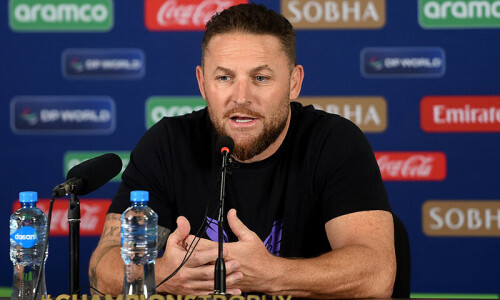
Harry Brook, currently the vice captain and a generational talent with the bat, is favourite to succeed Buttler as England’s white-ball captain although coach Brendon McCullum has not confirmed an appointment.
McCullum and the managing director of England men’s cricket Rob Key are keen to ensure that whoever inherits the role should not have to deal with the shackles that rotation policies impose on a skipper.
“That’s something Keysy and myself and the ECB are trying to ensure, that we give every format the most amount of attention that we possibly can,” McCullum said. “It’s a tricky balancing act at times.”
Published in Dawn, March 2nd, 2025