
The Faiz Festival continues to be one of the many reasons one looks forward to the month of February in Lahore. Invariably held in February to commemorate the birth of our great poet and humanist Faiz Ahmed Faiz, it brings together people from all walks of life and locations. The Alhamra Art Centre continues to be the chosen venue for the mega event, which features a wide range of intellectual discourse and artistic expression, including an exhibition at the Art Gallery.
This year we saw America-based Pakistani artist Sarah Ahmad selected to represent Faiz’s message through art. Ahmad’s works have been featured worldwide since 2012, and she is the recipient of numerous international awards. The current exhibition, curated by Pyari Azaadi and Asad Hayee, set ablaze the gallery with a mesmerising display of creativity that alluded, in particular, to the iconic poem by Faiz ‘Tum Apni Karni Kar Guzro’ [You do what you must].
More specifically, the exhibition illuminated geopolitical traumas absorbed by the land and its inhabitants in Pakistan’s Gilgit-Baltistan area, and also touched upon an incidence of racial violence that happened in 1921 in Tulsa, Oklahoma. The main focus was nonetheless on the people of Gilgit-Baltistan, who represent a marginalised community and who in recent times have also suffered through environmental disasters, including the Attabad landslide that caused many deaths and the destruction of homes.
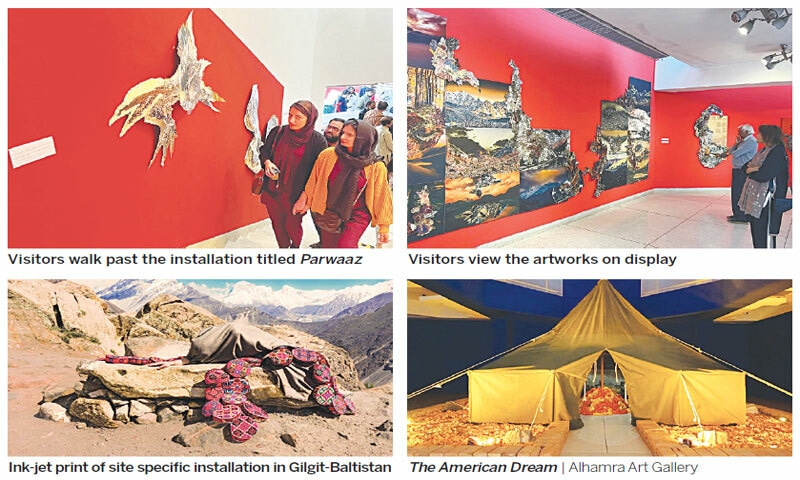
The exhibition started off with the dominance of the colour of revolution — bright red adorned many of the gallery walls, which featured an assortment of mixed-media works. These installations, titled Fractured Alchemy, made use of patterns found in nature and ink pen drawings on vellum with gold leaf on watercolour paper. These installations were an attempt to present a symbolisation of how human resilience can rebuild from the wreckage of the past.
An art exhibition at this year’s The Faiz Festival wove together themes of geopolitical trauma, environmental disaster and human endurance
The abstract visuals were an amalgam of designs found in parts of trees and driftwood that seem also like porous rocks, alluding to the ethos of oneness. The symbolism of alchemy was put across through golden colour in the backdrop, which was visually attractive but also a bit of a distraction to the sensitive message of resilience and rebirth.
Parwaaz was more direct. The mixed media landscape collages of photos of the Passu Glacier in Gilgit-Baltistan were printed with archival inks and mounted on gold leaf on canvas, as well as separately on an expanse of red-painted walls that led upwards towards the first floor of the gallery. All this came across as an uplifting visual feast, not only because of the bold colours but also because the way each collage took on the shape of a huge bird-like creature that is both real and imaginary.
As the viewer entered the upper floors of the gallery, another mesmerising visual experience awaited. The brilliant hues of the landscape of Gilgit-Baltistan were brought together through digitally manipulated photographs mounted on boards. These included photographs of the artist’s site-specific installations that feature colourful hand-embroidered Hunza caps. In addition, an installation that featured a large collection of such caps, placed on an expanse of mud in the centre of the gallery floor, added to the tactile experience, but also came across as poignant, since a person’s head gear must, ideally, as a mark of respect, not be placed at the level of anyone’s feet.
Towards the tail end of the exhibition, one saw a simple white tent surrounded by marigold flowers. On its inner walls were displayed the heartrending black and white photographs from the Tulsa massacre. In the centre of the tent one saw handcrafted fabric flowers, as well as real ones, and an assortment of light fixtures that created an ambience replete with the essence of human tragedies, as well as rebirth and resilience.
This was perhaps, in a nutshell, what the artist had tried to convey to her audience. No matter how extenuating the human condition is made to be, we must continue to light our candles of courage and hope, and rebuild even on the debris of destruction. Quoting the words of Faiz here: “Tum apni karni kar guzro/ Jo hoga dekha jaaega.”
‘Tum Apni Karni Kar Guzro’ was on display at the Alhamra Art Gallery from February 14-23, 2025.
The writer is an artist, art critic, educationist and activist with a postgraduate degree in art and public policy
Published in Dawn, EOS, March 2nd, 2025