Fazl slams govt over ‘lack of civilian decision-making’


• Deplores lack of govt writ in parts of KP, Balochistan
• Five bills passed amid opposition protest; president prorogues joint sitting scheduled for today
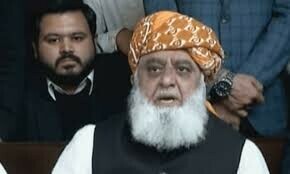
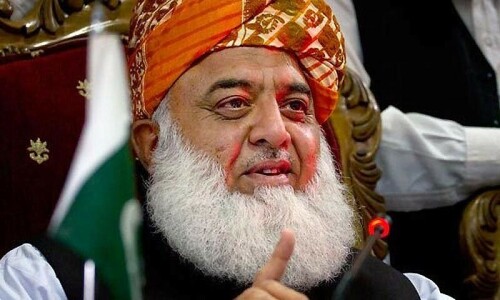
ISLAMABAD: Chief of his own faction of the Jamiat Ulema-i-Islam (JUI-F) Maulana Fazlur Rehman on Monday launched a blistering attack on the government’s handling of national security issues and warned that the country’s very existence was under threat due to lack of civilian decision-making.
Speaking on a point of order in the National Assembly after the house hurriedly passed five bills aimed at curbing human trafficking and organised beggary amid noisy opposition’s protest, the JUI-F chief cautioned that “Pakistan’s physical boundaries might be altered sooner rather than later” unless drastic measures were taken to address pressing concerns, including the lack of state writ in the provinces of Balochistan and KP as well as the newly-merged tribal districts.
There was a stunned silence during the Mr Rehman’s speech, and a few instances when the opposition members shouted ‘shame, shame’. PTI members, who had made two failed attempts to disrupt the proceedings by pointing out quorum and raised slogans during the passage of the bills, later heard the Mr Rehman’s speech in complete silence.
However, as soon as Law Minister Azam Nazeer Tarar took the floor to respond to Mr Rehman’s speech, the PTI members once again started sloganeering and one of its members pointed out quorum for the third time. Deputy Speaker Ghulam Mustafa Shah adjourned the sitting till Tuesday morning (today) after declaring the house not in order due to a lack of quorum, for which the presence of 84 members is required in the 336-member house.
Fazl’s warnings
Taking the floor, the JUI-F chief alleged polices were being “made in closed doors by those who are above the government, above politicians and above the parliament and we are not allowed, even for a moment, to give any proposal”.
Alleging that there has been no writ of the state in Balochistan and KP, he said armed groups were in a state of war in both provinces. “Had I asked the prime minister [Shehbaz Sharif] as to what is happening in the tribal areas, he would have simply stated that he doesn’t know,” said Mr Rehman, while lamenting the government over its failure to establish civilian authority.
“The decisions are being completely made by the establishment while sitting in palaces and behind closed doors and the government is there only to endorse them,” said the JUI-F chief, amid slogans of “shame, shame”. He said politicians and parliament had to face the people’s wrath over these decisions.
Without elaborating, Mr Rehman said there were areas in his constituency which had been ‘vacated even by the army’. “Whose writ will be there and who will be occupying a war-ravaged place with no presence of the police and the army?” he asked.
The JUI-F chief warned that five to seven districts in Balochistan were “in a position to announce independence”, adding that the UN would recognise them the next day in such a case. Similarly, he claimed that there was no government’s writ in the southern parts of KP where police checkposts had been closed down and the police officials were under a siege of the “armed groups” controlling of the area.
Stating that long wars along the borders were warning of “geographical changes”, Mr Rehman said if US President Donald Trump could talk about Gaza, he could demand control over Pakistan’s tribal areas. He also warned that the international forces wanted to have their control over the country’s atomic bomb and missile programme. He also hit out at the government for allowing the IMF representatives to meet the bench and bar representatives.
Mr Rehman, however, offered his cooperation to the government, making it conditional to the establishment of the civilian rule and decision-making powers for parliament.
Meanwhile, the National Assembly passed five bills with majority votes, including the Prevention of Trafficking in Persons (Amendment) Bill, the Prevention of Smuggling of Migrants (Amendment) Bill and the Emigration (Amendment) Bill aimed at curbing human smuggling. All the bills have previously been passed by the Senate.
Joint session prorogued
Meanwhile, President Asif Ali Zardari on Monday prorogued the joint session of parliament, which was scheduled to be held on Feb 18 (Tuesday), for an indefinite period.
The session of was originally convened on Jan 24, under Article 54(1) of the Constitution.
However, the president has now prorogued the sitting.
Published in Dawn, February 18th, 2025