 Pakistan’s economy has gained more strength during the course of last four years. Its macroeconomic indicators have posted marked improvement indicating sustained growth.
During the last five years (2000-05), there is a tremendous rise in inflow of remittances, exports, micro-credit, development expenditure, revenues, and low inflation rate which has only gone up last year but it is still below double-digit level.
The government’s poverty reduction strategy being followed for the last six years include: sustaining higher growth momentum, promoting social development, pursuing good governance and protecting the vulnerable segments of the society. Poverty and social sector related expenditures under the strategy are the most important fiscal intervention to target the poor and vulnerable sections of the society.
In 1997, Noble Laureate Amarta Sen said “Unlike agricultural growth, which often reduces poverty only by increasing mean consumption, the government expenditure reduces poverty both by increasing mean income and improving the distribution of income”.
The spending on social sector witnessed a rise during the last five years. It was less than Rs100 billion six years ago and it increased to over Rs300 billion last year.
Over the last six years, the government has spent over Rs1 trillion in this area and is expecting positive results. Pakistan has invested heavily on infrastructure projects during the last three years which has enhanced the level of economic development.
Have such policies and programmes improved the living conditions of the people? Have they reduced poverty and improved social indicators? These are valid and frequently asked questions. The efforts to strengthen the economy will not be completed unless macroeconomic gains trickle down to masses in terms of improved living conditions.
The concept of pro-poor growth has recently emerged in the diction of economics. It is not the economic growth per se but quality of the growth that makes dent on poverty. The macroeconomic instability arising from unsound policy has a direct bearing on the well-being of the poor. The pro-poor growth means growth with macroeconomic stability and sectoral composition of growth matters depending on extent of labour intensity.
Agriculture and construction sectors are invariably more labour intensive than manufacturing and services sector. But within manufacturing and services sectors there are pockets of labour intensive sub-sectors. The small and medium industries contribute bulk of the manufactured exports and wholesale and retail trade account for bulk of services sector employment. The crop sector in the agriculture for example generates more than 40 percent of rural employments directly.
The major crop component witnessed a 57 per cent rise in value addition in nominal terms which implies transfer of huge amount to rural areas. When we see patterns of economic growth during the last three years in this backdrop, the pro-poor growth accounted for around 70 per cent of economic growth during the last year’s growth of 8.4 per cent and significant contribution to growth in 2002-03 and 2003-04.
The industrial development is crucial because of limited capacity in the agriculture sector for the employment of growing labour force. The government has provided various incentives to boost industry and increase competitiveness. The large-scale manufacturing grew at an average rate of 11.1 per cent during the last five years which is highest persistent growth for any period in recent economic history.
Such an impressive growth in industrial production is not concentrated on few items; rather it is broad-based with construction related industries, consumer durables, capital goods etc witnessing tremendous growth.
Some five years ago, the country was producing nine million tons of cement. This year the production is likely to touch over 14 million tons. Five years ago, the country was producing some 33,000 cars. This year the production is expected to touch 125,000. Five years ago, the country was producing 95,000 motorcycles. This year, it is likely to produce 450,000. The prices of motorcycles have nosedived.
Considerable advancement has been made in the production of consumer durables. Five years ago, the country was producing 121,000 TV sets. This year the country is expected to produce 851,000 TV sets.
The prices have also come down. Five years ago, the country was producing 4821 air conditioners. This year 140,000 air conditioners will be produced. Similarly, five years ago, the country was producing 211,000 refrigerators. This year, the target is to produce 630,000 refrigerators.
These are the clear examples of growing consumer demand and emergence of a strong middle class. This is also a clear indication of the rising levels of income. The growth in large-scale manufacturing is not limited to consumer durables. This must have generated some employment. Call centres, information technological explosion, exploding mobile business and growth in many sectors should have created employment.
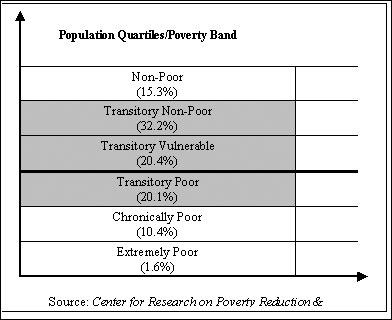
As a study by Centre for Research on Poverty Reduction and Income Distribution (CRPRID) suggests that poverty is characterized by large amounts of clustering around the poverty line. This suggests that there exists a high proportion of vulnerable population which is likely to move in and out of poverty as a result of changing economic conditions.
The concentration around poverty line implies that the poverty incidence can change dramatically or a large section of the population can be categorized as vulnerable – i.e. it is likely to fall into poverty as a result of a shock or move above the poverty line through targeted interventions of the government.
Estimates suggest reduction in poverty between 1990-91 and 1993-94, by approximately five percentage points, followed by an upward spike of four percentage points to 1998-99, and reduction of 6.7 per cent between 2001 and 2005. The wide swings in poverty in Pakistan are a norm rather than an exception.
Poverty is a concept that spans a range of dimensions, such as health, education, mortality and security that is not correlated with conventional measures of income poverty. But we have to live with the international norms and calculate the income poverty as others do.
There is another kind of statistics which reveal our poor show on these counts.
There can be a debate over improvement in the statistics and the government should not be complacent over a meagre reduction in poverty to the extent of 6.9 per cent.
More than one-fourth of our population lives below poverty line and difficult times are ahead.