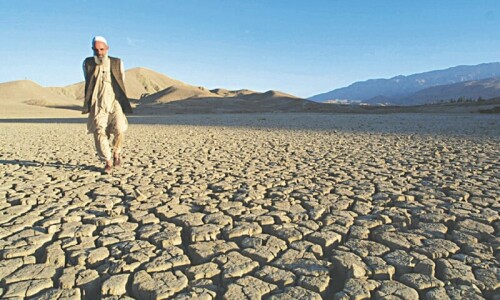
RAWALPINDI: The Pakistan Meteorological Department (PMD) has warned of a drought-like situation in most parts of the country due to scarce rainfall.
In an advisory on Tuesday, PMD’s National Drought Monitoring Centre (NDMC) said the plains did not receive significant rainfall, which aggravated the drought conditions.
The alert was a continuation of the Drought Advisory-I issued on December 9, the PMD added.
The rainfall was 40 per cent lower than normal across Pakistan from September 1, 2024, to January 15, 2025.
The major anomalies were observed in Sindh, where the rainfall was 52pc lower than normal, Balochistan (45pc lower) and Punjab (42pc lower).
Downpour was 40pc lower than normal between Sept 24 and Jan 15; El Niño likely to persist till March
The lower rainfall has created mild drought-like conditions in different areas of the country, including rain-fed areas.
In Punjab, mild drought conditions were observed in the Potohar region — Attock, Chakwal, Rawalpindi/Islamabad—, Bhakkar, Layyah, Multan, Rajanpur, Bahawalnagar, Bahawalpur, Faisalabad, Sargodha, Khushab, Mianwali and D.G. Khan.
In Sindh, Ghotki, Jacobabad, Larkana, Shaheed Benazirabad, Dadu, Padidan, Sukkur, Khairpur, Tharparkar, Hyderabad, Thatta, Badin and Karachi have witnessed drought-like conditions.
In Balochistan, Ormara, Kharan, Turbat, Kech, Panjgur, Awaran, Lasbella, Nokkundi, Dalbandin and adjacent areas were witnessing a similar situation.
The ongoing drought conditions were “likely to aggravate further” as no significant rainfall is expected in rain-fed areas of Punjab, Sindh and Balochistan, the advisory stated.
No improvement in sight
The PMD added that the situation was unlikely to improve as the second half of the season is expected to be as dry as the first half.
The above-normal temperatures forecast may favour the turning of mild drought conditions into moderate drought, especially in rain-fed areas of the country.
The NDMC is “continuously monitoring the meteorological conditions”, the advisory stated, adding the emergence of flash drought — a period of rapid drought intensification — is also anticipated in upcoming months in light of scarce rainfall and increasing temperatures. The advisory urged the authorities to take pre-emptive measures in drought-prone areas.
Seasonal report
The PMD also stated that during January-February-March 2025, negative climate indicator like El Niño Southern Oscillation (ENSO) is expected to persist.
According to the US’ National Oceanic and Atmospheric Administration, ENSO is a climate phenomenon involving changes in the temperature of water in the central and eastern Pacific Ocean. This oscillating warming and cooling pattern, referred to as the ENSO cycle, affects rainfall in many parts of the world.
The PMD added that the transition of the Indian Ocean Dipole (IOD) from “negative to natural phase” is also likely to persist during the season.
As per the seasonal outlook, normal to slightly above normal rainfall is expected in central and southern Khyber Pakhtunkhwa, most parts of Punjab and adjoining areas of Azad Kashmir due to prevailing western weather systems.
Upper KP, Hazara, Gilgit-Baltistan, Sindh and eastern Balochistan are expected to receive near-normal rainfall. However, western Balochistan is expected to receive slightly below-normal rainfall during the season.
The second half of the season is expected to be relatively dry in comparison to the first half, the PMD stated.
Water reservoirs
The PMD added that normal to slightly above-normal rainfall in northern regions during the early part of the season may help replenish reservoirs and maintain adequate water supplies. However, below-normal rainfall in southern Balochistan could strain local water resources, affecting irrigation and domestic water availability.
The availability of water for irrigation may be sufficient in the north, but close monitoring of reservoir levels will be needed to ensure adequate supply for the second half of the season, it said.
Warmer temperatures and below-normal rainfall during the second half of the season may cause the early onset of pollen season in Islamabad and Rawalpindi, the PMD warned.
Meanwhile, above-normal temperatures could lead to the early onset of heat stress in vulnerable populations, particularly in southern regions, during March.
Published in Dawn, December 22nd, 2024