• Canadian PM says his ‘internal battles’ mean he is no longer the best option to lead Liberal Party into next election
• Governor-general asked to prorogue parliament until March 24 to allow for leadership transition
• Announcement comes ahead of Trump’s inauguration
TORONTO: Canadian Prime Minister Justin Trudeau announced on Monday that he will resign as leader of the Liberal Party, but continue to serve as prime minister until a successor is chosen.
Speaking outside his Rideau Cottage residence, Trudeau said the decision came after months of reflection, and consultations with his family and senior Liberal Party officials.
“I intend to resign as party leader and as prime minister after the party selects its next leader through a robust, nationwide competitive process,” he said. “Last night, I asked the president of the Liberal Party to begin that process.”
The announcement, coming less than a year before a scheduled federal election, signals a major shift in Canadian politics. Trudeau has led the Liberal Party since 2013 and has been Prime Minister since 2015, when he took the party from third place in Parliament to a majority government.
His tenure has seen significant initiatives in climate policy, Indigenous reconciliation, and social programmes like national childcare. However, declining public support, mounting internal dissent, and recent by-election losses have placed the Liberals in a precarious position.
“This country deserves a real choice in the next election,” Trudeau said. “It has become clear to me that if I am having to fight internal battles, I cannot be the best option in that election.”
The decision was finalised over the holiday season, Trudeau explained, following extended discussions with his family. “Over the holidays, I had the chance to reflect. I’ve had long talks with my family about our future,” he said. “Last night, over dinner, I told my kids about the decision I am sharing with you today.”
In addition to beginning the leadership process, Trudeau confirmed that he had asked Governor-General Mary Simon to prorogue Parliament until March 24. He argued that this would provide the Liberal Party with the necessary time and space to focus on its leadership transition.
“Parliament has been paralysed for months after what has been the longest session of a minority parliament in Canadian history,” he said. “Proroguing allows for the focus required to navigate this transition.”
The announcement follows growing calls from within the Liberal Party for Trudeau to step aside, a movement that gained momentum after the resignation of Finance Minister Chrystia Freeland in December.
Freeland, once seen as one of Trudeau’s closest allies, criticised his leadership as she stepped down, further emboldening dissenting voices within the party. By late December, a growing number of Liberal MPs had publicly urged him to resign.
“I am a fighter, and I am not someone who backs away from a fight, particularly when a fight is as important as this one,” Trudeau said. “But it has become obvious to me that I cannot be the one to carry the Liberal standard into the next election.”
The Liberal Party’s leadership contest is expected to attract a diverse slate of candidates, including former Bank of Canada governor Mark Carney, Finance Minister Dominic LeBlanc, and Foreign Affairs Minister Mélanie Joly. The timing of the leadership race will be critical, with the next federal election tentatively scheduled for October but widely expected to occur earlier.
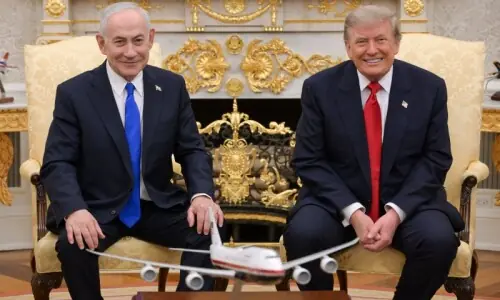
Trudeau’s resignation also comes at a time of heightened economic and political uncertainty, including President-elect Donald Trump’s plans to impose tariffs on Canadian imports. The evolving trade tensions and domestic economic challenges, such as inflation and housing affordability, have put additional strain on the Liberal government’s agenda.
First elected as Liberal leader in 2013, Trudeau has been a dominant figure in Canadian politics, combining charisma with a progressive policy platform that resonated with many voters. His initial victory in 2015 was seen as a repudiation of the Conservative government under Stephen Harper, but subsequent elections in 2019 and 2021 returned minority governments, reflecting a more divided electorate.
“This has been one of the most difficult decisions of my life,” Trudeau said as he concluded his remarks. “But I know it’s the right one for my family, for my party, and for the future of this country.”
Published in Dawn, January 7th, 2025