• Iran’s supreme leader orders military to update target list
• Araghchi says Vance letter discussed at high level, rules out direct talks with US
• Rubio confirms Trump ‘hasn’t made decision’ on fresh strikes
• Doha talks slash proposed timeline for reopening Strait of Hormuz to 48 hours
TEHRAN: Iran’s Supreme Leader Ayatollah Mojtaba Khamenei on Saturday warned the United States and Israel that any new attacks would draw an immediate response without geographical limits, as regional mediators sought to avert renewed fighting after the US midterm elections.
“Any level or type of threat must be met with an immediate, impactful and geographically unrestricted response,” the supreme leader told top military commanders in a statement posted on his official Telegram account.
This was the first reported meeting between Khamenei and military top brass since he took the helm in March after the assassination of his father, Ayatollah Ali Khamenei, in US-Israeli strikes on Feb 28.
Khamenei, unseen publicly since taking power, met with Armed Forces Chief of Staff Maj Gen Ali Abdollahi, army chief Amir Hatami and Revolutionary Guards commander Ahmad Vahidi.
He ordered commanders to update Iran’s target list to include “all types of tangible and intangible assets belonging to the American-Zionist enemy”, citing high readiness along the Gulf coast, the Strait of Hormuz, the Gulf of Oman, and Iran’s borders.
Amid the warning, Iranian negotiators held talks in Doha with Qatari mediators on Saturday to discuss paths out of war in the Gulf and avert new fighting after Tuesday’s US midterm elections.
Saturday’s talks followed more than 12 hours of discussions on Friday in Tehran between Iranian and Qatari envoys, said a source briefed on the negotiations who spoke on condition of anonymity, adding that the talks were coordinated with Washington.
Regional countries anticipate that US President Donald Trump, who held off on strikes ahead of Tuesday’s vote, could restart attacks afterwards.
This week, US Vice President JD Vance sent a letter to Iran’s security chief, Mohsen Rezaei, at Trump’s direction to revive talks, though Trump played it down as an effort only to allow medical supplies into Iran.
Meanwhile, Tehran deemed unsatisfactory a seven-day trust-building plan brought by Qatari mediators a week ago.
Iran has proposed its own seven-day plan since September, rejected by Trump, calling for Washington to lift its port blockade, unfreeze assets and approve an Iranian-backed route through the Strait of Hormuz before reopening the waterway.
Addressing the diplomacy on Saturday, Iranian Foreign Minister Abbas Araghchi told Al Jazeera that Tehran had studied Vance’s letter in high-level meetings, but said no direct talks with US officials are currently scheduled.
“The American side’s attempt to open the door to dialogue and understanding more broadly is a positive step,” Araghchi said. “If Washington’s goal in sending this letter is to stir up discord, it would be yet another mistake to add to its previous ones.”
“We see no need to meet with the Americans at present. Our conditions are clear, and mediators are continuing their consultations regarding them,” he added, noting his aide is in Qatar as Qatari and Pakistani mediators review proposals on Iran’s nuclear dossier.
Araghchi said Qatari talks reduced the implementation period for Iran’s proposal to open the Strait of Hormuz from five days to two days.
“Our conditions include lifting the sanctions imposed following the Islamabad memorandum and reducing US forces in the region,” Araghchi said.
“We demand the restoration of oil waivers and the release of all our frozen funds, including those held in Qatar.” He also demanded recognition of Hormuz shipping routes discussed with Oman, warning on X of no more “red lines” and saying Iran “will not surrender”.
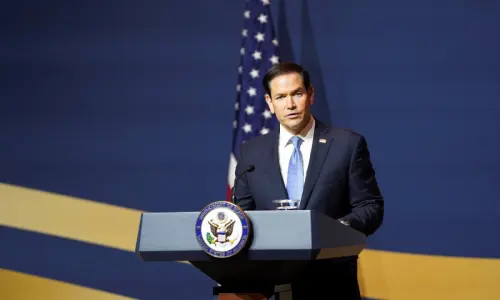
In Atlanta, where he was hosting G20 foreign ministers, US Secretary of State Marco Rubio said Saturday that Trump “hasn’t made a decision” on fresh strikes against Iran.
“We can achieve military objectives if we seek to,” Rubio told media, adding, “I have no announcement in that regard with you today, and nor do we take any of it lightly.”
While slamming Tehran for “actively and openly” targeting commercial vessels, he expressed Trump’s preference for diplomacy without setting a timeline, saying “if there is a diplomatic solution, we would be open to it”.
Regional leaders voiced alarm on Saturday over potential escalation after a June interim agreement failed to secure a lasting ceasefire. Speaking at the IISS Manama Dialogue security summit in Bahrain, Egyptian Foreign Minister Badr Abdelatty said he was “extremely worried” about renewed war.
“The second round will be more dangerous, more destructive, and it will lead to nowhere. We have to draw lessons from the past,” he said.
Speaking at the same forum, Saudi Vice Minister of Foreign Affairs Waleed ElKhereiji said efforts were underway to prevent military escalation and end the crisis.
Meanwhile, maritime tensions persisted on Saturday in the Strait of Hormuz, which normally carries one-fifth of global oil consumption and where Iran’s blockade has spiked energy prices.
Iranian state television said two fishermen from Qeshm, who went missing after an “attack by the American enemy on their fishing boat this morning, have been found”. State TV earlier cited a provincial official saying two other fishermen were wounded.
Separately, Iran’s navy said that a tanker caught fire after striking naval mines in a prohibited area east of the Strait of Hormuz, after the Revolutionary Guards said on Friday that three oil tankers were halted following unspecified incidents or hitting mines.
Beyond restrictions on shipping, Iran has previously warned it would consider severing undersea cables in the strait.
Published in Dawn, November 1st, 2026