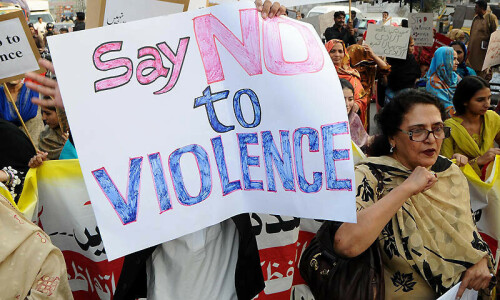
EVEN as the UN’s 16 days of activism against gender-based violence (Nov 25 to Dec 10) was being observed across the globe, including in Pakistan, a young female lecturer and mother of three was brutally murdered by her husband in an incident of so-called honour killing in village Bakr Jamali, Sindh. The horrifying incident sent shockwaves across the area.
The victim had passed the Sindh Public Service Commission examination and was working as a lecturer in the village. She belonged to a well-off and educated family. The culprit was arrested. He admitted to his crime and said he killed his wife out of ‘ghairat’ (honour). The family of the victim claimed the man killed her out of greed for money and property. The victim’s family had provided her with a good education, and allowed her to marry the person of her choice. Tragically, they received her bullet-riddled body, while three innocent little children cried for their mother.
Another young woman was subjected to horrific torture before being murdered by her husband in a village in Chakwal. Two sisters were killed by their father and brother in Vehari last year for contracting free-will marriages. In Swat, 20 women were killed in the first five months of 2024. Out of these, 10 women were murdered in the name of ‘honour’.
According to a recent UN report titled Femicides in 2023: “Some 51,100 women and girls were killed at home by people closely related to them in 2023, accounting for 60 per cent of all female homicides. In too many cases, victims of femicide had previously reported violence and their killings could have been prevented.” The report mentioned that, on average, 140 women and girls were killed every day by someone in their family worldwide. “This suggests that the home remains the most dangerous place for women and girls in terms of the risk of lethal victimisation.”
There is no honour involved in cold-blooded murder.
The murder of women is taken as a mere statistic; no report, no data can capture the humiliation, pain, trauma and torture a woman goes through before she is killed by a family member. The very few cases mentioned here are enough to highlight the severity of the issue of women killed in the name of honour in Pakistan; even more painful is society’s acceptance of the practice, thus normalising murder.
To address the issue, the Criminal Law (Amendment) (Offences in the name or pretext of Honour) Act, 2016, was passed. The qisas and diyat laws provided an option to families to forgive the culprit, who, usually, was a family member or relative, allowing criminals to go unpunished. This legal gap was addressed by the Honour Killing Act, 2016, which eliminated the possibility of family members forgiving those who had committed the crime.
This new law fixed a loophole that allowed killers to be spared punishment if the family (father, son, or brother) forgave them. The law makes the crime of honour killing a non-compoundable offence. The law included taazir as a prerogative of the court, despite the waiver of qisas by the victim’s legal heirs, with a minimum lifetime sentence.
Lack of support mechanisms, family support, and shelter homes/ protection centres are contributing factors to the scourge. In such a patriarchal society, women survivors are reluctant to report cases in hostile, gender-insensitive police stations or file a case in court.
A major reason for this crime is the acceptance of gender-based violence in society and systemic gender bias in the state machinery, including the police, judiciary, and prosecution.
Honour crimes and femicide should be declared crimes against the state. When the family does not pursue the case, the state must pursue it till justice is done. Along with legal amendments and effective implementation of the laws, a strong police and community-level mechanism of prevention of the crime must be developed and enforced. Institutions responsible for protecting women and providing justice can themselves be discriminatory and have biased gender representation.
Women recruits form less than 2pc of Pakistan’s entire police force. Representation of female judges in the judiciary is very low. Till recently, according to the Law and Justice Commission, there were 3,142 judges and judicial officers in the country, the vast majority (2,570) being male; of the 572 female judges and judicial officers, 565 are in the district judiciary, and seven in the superior courts. Needless to say, more women should be inducted.
Changing anti-women mindsets and behaviour will take generations. What can be done immediately is to implement reforms in the police and judiciary. Crimes against women are a gross violation of the Constitution. The state must take full responsibility to protect its women as equal citizens of Pakistan.
The writer is a lawyer.
Published in Dawn, January 2nd, 2025