0
0


THERE have always been demands for the restoration of democracy during military dictatorships. And whenever, after a long struggle and sacrifices in terms of lives, limbs and livelihoods by the lower classes, the democracy is finally restored, the same warriors suffer the most.
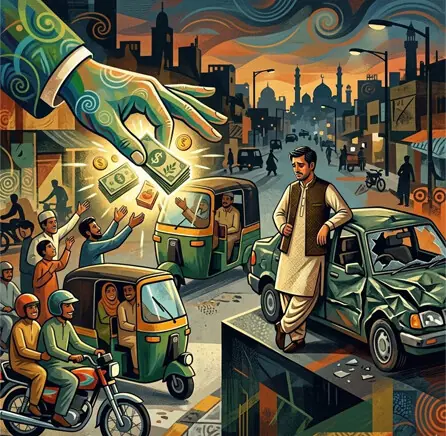
The version of democracy we have in Sindh is a test case. What we have is actually dictatorship under the garb of democracy. The ruling party collects herds of sycophants comprising big and small landlords to run the provincial machinery, while dedicated party workers remain completely sidelined.
All decision-making positions are distr-ibuted among new entrants who mostly happen to be feudal lords and their scions who had been the ones persecuting workers and activists when the party was not in power. Moreover, the voters and workers cannot approach the so-called elected elite due to the iron-clad circle of influence erected by the sycophants.
The public service delivery system has collapsed, and public resources and bud-gets are swallowed by mafias at different tiers of governance. The masses are reeling under a repressive and unres-ponsive system. Protests have lost their relevance as there is no mechanism to redress the grievances. As for the accoun-tability apparatus, it has been compro-mised through legislation.
There was some hope that the devo-lution of power to local governments would improve the level of governance and service delivery, but the local governments have proved worse because they are run by people elected on a party basis. All the ills of the provincial government have trickled down to union council (UC) level.
One fails to understand why those at the helm of provincial affairs in Sindh are bent on proving democracy as the worst form of governance in the country.
Gulsher Panhwer Johi Astute and decent
THE lapse of 17 years has not dimmed the sense of loss the people felt at the shocking assassination of Benazir Bhutto in Rawalpindi. Had she been alive today, the political scenario would have been entirely different as she was an intelligent, astute and decent politician who kept her distance from petty prejudices.
Despite serious threats to her life, she had bravely returned to her homeland because, in her own words, “the future of my country was greater”.
As a champion of human rights as well as democracy, she was respected all over the world. The United Nations General Assembly had conferred upon her the prestigious UN Human Rights Award posthumously.
The same was the case with the Tipperary International Peace Award. It is ironic that while the world honours and acknowledges the talents of rare Pakistanis, we ourselves hound, persecute and assassinate them for political reasons and petty prejudices.
Benazir could have chosen a life of luxury, peace and harmony, but the plight of the poor and the rule of dictatorship in the country did not allow her to rest and relax. She chose to tread the rough, tough and thorny path.
She firmly believed that the poor, the dispossessed and the have-nots were her constituency.
The affluent class may not have liked Benazir, but the poor would always
love and adore her as a great leader. She was, indeed, unique and matchless.
Inayat Balouch
Khairpur Mirs
Published in Dawn, December 27th, 2024