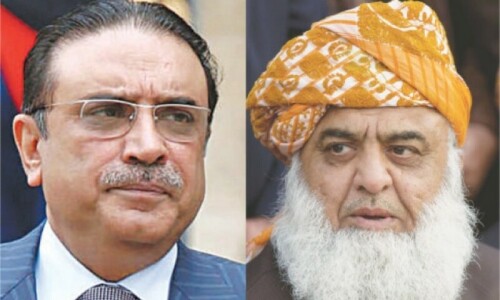
THE stand-off over the Societies Registration (Amendment) Act, 2024 — a draft law dealing with registration of madressahs — between the state and religious forces remains unresolved, with an influential section of clerics hardening their position over the matter. The law has been championed by the JUI-F and was passed by parliament earlier this year, but President Asif Zardari has refused to give his assent.
On Tuesday, the Ittehad Tanzeemat-i-Madaris Pakistan, a platform that brings together five madressah boards, endorsed the JUI-F’s stance on the bill and refused to cede their ‘autonomy’ to the state. Mufti Taqi Usmani, speaking for the Ittehad, said they had backed the 2019 madressah reforms — bringing seminaries under the education ministry — “under pressure”, and that religious schools in Pakistan would not become “subservient” to the state as was the case in Saudi Arabia, Egypt, etc.
In this case both sides — the clerical old guard and the ruling parties — are responsible for creating unnecessary controversy. The clerics should avoid using the dispute over the bill to mobilise their students and supporters, and show restraint as the country cannot afford more upheaval. The state, meanwhile, should admit that it used the bill in question as a political tool to secure the JUI-F’s support for the 26th Amendment and that the madressah reforms of 2019 cannot be reversed, though any genuine concerns of the ulema can be addressed. Fortunately, both sides have kept the door for dialogue open, and a negotiated settlement is required for this sensitive issue, rather than deciding the matter on the streets.
This paper has argued that as madressahs are educational institutions, they should come under the purview of the provincial education departments. Therefore, the bill should be reconsidered, and the Directorate General of Religious Education, which was formed to oversee seminaries, should not be rolled back.
The importance of madressah registration is highlighted by the fact that no one has exact figures for the number of religious schools in Pakistan. There are only educated guesses. Primarily, the state must know exactly how many madressahs exist, what they teach, and where they get their funds from. These are not unfair demands. Moreover, if the state can maintain control over religious education in ‘brother’ Muslim countries, what makes us exceptional?
It is also true that vocational training and life skills should be taught in seminaries, as not all of the thousands of madressah students that graduate every year can take up religious vocations. If left to their own devices, madressahs can become breeding grounds for extremism. The Lal Masjid/ Jamia Hafsa fiasco is a prime example of why the state needs to know what is going on within religious institutions. Hence, the clerics should dial down the rhetoric, and resolve this issue amicably.
Published in Dawn, December 19th, 2024