Apex court scrutinises scope of military courts

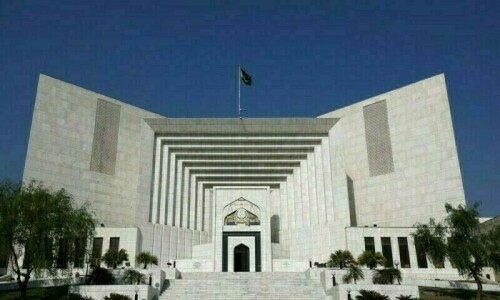
ISLAMABAD: The questions about the legitimacy of military trials of civilians in light of Article 8 were the highlight of Thursday’s hearing as the Supreme Court’s constitutional bench took up appeals against military trials concerning the May 9 attacks on army installations.
Headed by Justice Aminuddin Khan, the seven-member constitutional bench resumed the hearing on a number of Intra-Court Appeals (ICAs) against the Oct 23, 2023 five-judge order that nullified the trial of civilians by the military courts. Justice Jamal Khan Mandokhail, Justice Muhammad Ali Mazhar, Justice Syed Hasan Azhar Rizvi, Justice Naeem Akhtar Afghan, Justice Musarrat Hilali, and Justice Shahid Bilal Hassan were also part of the bench.
Justice Mandokhail wondered how an individual, not subject to the Pakistan Army Act (PAA) 1952, could be deprived of fundamental rights guaranteed under the Constitution if tried under the army’s disciplinary structure. Justice Mandokhail noted that the army discipline would be adversely affected in case ordinary civilians were also brought into its ambit.
Justice Mandokhail said army discipline would apply to someone in the military just like the agriculture department’s rules would apply to someone working in that department, questioning how the army act could be applied to someone who was not part of the army. Will it not be a violation of Article 8 to bring an unrelated person under the military discipline, he wondered.
Justice Mandokhail asks how Army Act can be applied to someone not part of military
A civilian who kills a soldier will always be tried in the ordinary court of law; besides, attacking military installations was also a crime to be tried under the Anti-Terrorism Act (ATA), Justice Mandokhail observed.
Defence Ministry lawyer Khawaja Haris argued that the Oct 23, 2023, judgement in the military trials of the civilians had two parts since the verdict had held that Section 2(1) d(i) and 2(1) (d)(ii) and Section 59(4) of the PAA were ultra vires of the Constitution and therefore of no legal effect.
Justice Mandokhail, however, observed that the entire case revolved around Article 8, whereas Justice Muhammad Ali Mazhar wondered whether the five-judge bench had declared the provisions of the PAA to be in conflict with Article 8 and what was the justification given in the decision about the conflict between the provisions of the Army Act and Article 8.
Justice Mandokhail also questioned how a person who was not in the armed forces could come under its discipline. However, the counsel contended that if law permitted, military discipline would be applied to civilians. The counsel contended that the court did not have the authority to annul the provisions of the PAA.
During the hearing, Justice Hilali wondered whether lawyers were allowed in the military court trial and whether a complete record was also provided to the accused in the military court. The counsel said the accused in the military court were provided with a lawyer as well as all relevant materials.
Justice Hilali also sought details of the rules under which the trial of civilians is being conducted in the military courts, as well as details of FIRs registered against those involved in the May 9 violence.
The constitutional bench will resume the hearing on Friday.
Published in Dawn, December 13th, 2024