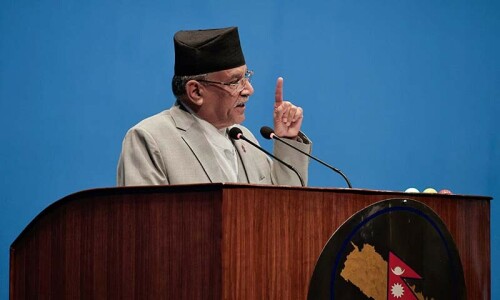
Nepal’s veteran communist politician KP Sharma Oli, returning as the country’s prime minister this year for a fourth time, sought to kick-start infrastructure projects with Beijing this week amid a pivot away from India’s sphere of influence.
Oli arrived in China on Monday for a four-day visit, his first to a foreign country since his July swearing-in, and breaking tradition by not making New Delhi, with which Kathmandu has centuries-old ties, his initial port of call.
Oli has so far been greeted by familiar pledges of assistance, but no new investment.
The nine deals that Nepal signed with China on Tuesday had been previously agreed.
During Oli’s meeting with President Xi Jinping on Tuesday, the Chinese leader reiterated that China would help Nepal transform from a landlocked country into a “land-linked” one, and would continue to support Nepal’s economic development “to the best of its ability”, according to Chinese state media.
Kathmandu, which signed up for Xi’s Belt and Road Initiative aimed at building China’s infrastructure and trade links with the rest of the world, says no project has yet been implemented since an initial pact was inked in 2017, despite being keen to break ground on projects, including road upgrades and new transportation corridors.
Oli is seeking to deepen and recalibrate economic ties with Nepal’s northern neighbour while seeking to reduce its traditional dependence on India to the south.
India accounts for two-thirds of Nepal’s international trade while China has a share of just 14 per cent. But China is a bigger two-way creditor, having lent more than $310 million, World Bank data shows, or $30m more than New Delhi.
During his first term as prime minister in 2016, Oli cut a petroleum deal with China after New Delhi imposed a six-month oil blockade on Kathmandu a year earlier.
That upended India’s status as Nepal’s sole fuel supplier and paved the way for increased cooperation with Beijing.
Debt fears
China has since extended Nepal a loan of $216m to build an international airport in Pokhara, the second-largest city about 200 kilometres west of Kathmandu, which began operating last year.
But the Chinese-built airport, claimed by Beijing as a symbol of Belt and Road success, has grappled with problems, such as a lack of international flights, due to India’s refusal to let planes use its airspace to reach Pokhara.
Debt concerns have also spurred debate within Oli’s coalition government, with the Nepali Congress party, a key supporter of Oli being in office, opposing any project funded by loans.
Ahead of his China visit, the coalition partners, including Oli’s own Communist Party of Nepal (Unified Marxist Leninist), agreed to use grants and not loans from China for Belt and Road projects.
Sri Lanka, a key recipient of Belt and Road loans to fund transport and power projects, defaulted on foreign debt in May 2022, offering a sobering reminder of the risks of unsustainable borrowing.