KP declares three-day mourning over PTI workers’ deaths

• Speaker denounces brutality, claims demonstrators targeted by snipers, run over
• Gets carried away and likens crackdown to ‘East Pakistan debacle’
• Alleges attempts were made on CM Gandapur’s, Bushra’s lives
• Balochistan Assembly passes resolution seeking ban on PTI amid opposition walkout
PESHAWAR / QUETTA: The Khyber Pakhtunkhwa government has declared a three-day mourning period across the province over the killing of Pakistan Tehreek-i-Insaf (PTI) workers during a protest in Islamabad that abruptly ended after a late-night government crackdown earlier this week.
The announcement was made during an emergency session of the KP Assembly, chaired by Speaker Babar Saleem Swati late on Thursday night. The session, earlier scheduled for Dec 2, was convened at 9pm on Thursday in response to the Islamabad incident.
Mr Swati condemned the actions taken against the PTI protesters, alleging that fundamental constitutional rights, including the right to peaceful protest, had been denied. “The Constitution guarantees the citizens right to express themselves and protest peacefully, but these rights have been snatched by the institutions and powers that be,” he said.

The political powers that raised their voice for upholding the Constitution were “massacred mercilessly”, he said, before getting carried away to claim that the institutions had “repeated the history of Palestine and Israel” on directions of the federal government.
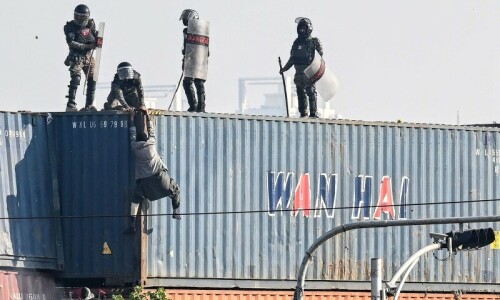
Mr Swati accused security forces of targeting unarmed demonstrators with snipers, destroying vehicles and using excessive force, including running over protesters.
He further claimed that bodies of deceased workers were missing and the number of those unaccounted for was rising. He regretted that the footage of these acts was being broadcast worldwide, yet Pakistani media remained silent.
“We have experienced this and we lost East Pakistan [Bangladesh] due to the same experiments. They [Bangladeshis] were filmed naked and treated inhumanly,” he said, adding that “the same is now being repeated in West Pakistan”.
The issue of PTI marchers’ deaths has remained a major point of contention between the government and the opposition party.
The government has maintained that no fatalities occurred during the law enforcement action to disperse the PTI marchers. However, Khyber Pakhtunkhwa Chief Minister Ali Amin Gandapur alleged on Wednesday — a day after the crackdown — that hundreds of party workers were killed or injured due to “direct fire by law enforcement agencies”.
Meanwhile, at least five men who were said to have lost their lives in the action against the PTI marchers were laid to rest in various parts of Khyber Pakhtunkhwa, including four on Wednesday and one on Thursday.
Speaker Swati also alleged that CM Gandapur and Bushra Bibi were targeted in attempted attacks during the protest and questioned whether the nation could endure such levels of brutality.
He highlighted the plight of PTI lawmakers Anwar Zeb and Malik Liaqat, whom he claimed were arrested near the KP-Punjab border, calling their treatment an example of “fascism”. He also called for an inquiry into the deaths of law enforcement personnel during the protests.
KP Minister for Law Aftab Alam Afridi formally announced the three days of mourning in honour of the deceased workers.
The session was later adjourned for 7pm on Friday (today).
‘Ban on PTI’
Meanwhile, the Balochistan Assembly on Thursday adopted a resolution calling for a federal government ban on the PTI.
The resolution, passed by a majority, faced strong opposition, prompting a walkout by opposition members who condemned it as unconstitutional.
The session, presided over by Speaker Abdul Khaliq Achakzai, began later than scheduled. Parliamentary leader of the PML-N and Minister for Communications Saleem Ahmed Khosa moved a joint resolution on behalf of his party and PPP legislators.
However, opposition parties, including the National Party, Jamiat Ulema-i-Islam-Fazl (JUI-F) and Jamaat-i-Islami, opposed the resolution and criticised the move as undemocratic and unconstitutional.
“We will not allow this house to pass such a resolution easily,” National Party leader Dr Malik Baloch remarked.
He regretted that the parties that had struggled for democracy and the supremacy of the Constitution and made sacrifices were now moving this resolution for a ban on a party.
“What have we gained by imposing bans on NAP and the Communist Party, other than disgrace?” he questioned. “We do not want to be part of this sin, so we are walking out of the house.”
The resolution accused PTI of inciting nationwide riots, engaging in violent activities and pursuing a destabilising agenda that aligns with anti-state forces. It claimed that statements by the KP chief minister were part of an “enemy agenda”, citing attacks on federal institutions using official resources.
Mir Saleem Khosa, speaking in favour of the resolution, condemned PTI’s alleged violent actions, including attacks on security forces, state institutions and the media.
Provincial Minister Bakht Mohammad Kakar also supported the resolution, stating that there is no option but to impose a ban when a political party disregards constitutional principles and engages in abusive behaviour against institutions.
JUI-F member Nawab Aslam Raisani opposed the resolution, demanding that Imran Khan be allowed to participate in the political arena so that he could compete with other political parties.
Leader of the Opposition Yunus Aziz Zehri said, “If a ban is imposed today on one party, tomorrow other parties will face the same fate.”
Published in Dawn, November 29th, 2024