0
0

TEHRAN: Iran said on Sunday that it would hold nuclear talks in the coming days with the three European countries that initiated a censure resolution against it adopted by the UN’s atomic watchdog.
Foreign ministry spokesman Esmaeil Baghaei said the meeting of the deputy foreign ministers of Iran, France, Germany and the United Kingdom would take place on Friday.
“A range of regional and international issues and topics, including the issues of Palestine and Lebanon, as well as the nuclear issue, will be discussed,” the spokesman said in a foreign ministry statement.
Baghaei described the upcoming meeting as a continuation of talks held with the countries in September on the sidelines of the annual session of the UN General Assembly in New York.
The meeting also covering issues of Palestine and Lebanon expected on Friday
Japan’s Kyodo news agency, which first reported that the meeting would take place on Friday in Geneva, said Iranian President Masoud Pezeshkian’s government was seeking a solution to the nuclear impasse ahead of the inauguration in January of US president-elect Donald Trump.
“Views will be exchanged … on a range of regional discussions and subjects including the issues of Palestine, Lebanon and also the nuclear subject”, Baghaei said.
The return of Trump
In 2018, the then-Trump administration exited Iran’s 2015 nuclear pact with six major powers and reimposed harsh sanctions on Iran, prompting Tehran to violate the pact’s nuclear limits, with moves such as rebuilding stockpiles of enriched uranium, refining it to higher fissile purity and installing advanced centrifuges to speed up output.
Indirect talks between President Joe Biden’s administration and Tehran to try to revive the pact have failed, but Trump said during his election campaign in September: “We have to make a deal, because the consequences are impossible. We have to make a deal”.
On Thursday, the 35-nation board of governors of the UN’s International Atomic Energy Agency (IAEA) adopted a resolution denouncing Iran for what it called a lack of cooperation.
The move came as tensions ran high over Iran’s atomic programme, which critics fear is aimed at developing a nuclear weapon — something Tehran has repeatedly denied.
In response to the resolution, Iran announced it was launching a “series of new and advanced centrifuges”. Centrifuges enrich uranium transformed into gas by rotating it at very high speed, increasing the proportion of fissile isotope material (U-235).
“We will substantially increase the enrichment capacity with the utilisation of different types of advanced machines,” Behrouz Kamalvandi, Iran’s atomic energy organisation spokesman, told state TV.
The country, however, also said it planned to continue its “technical and safeguards cooperation with the IAEA”.
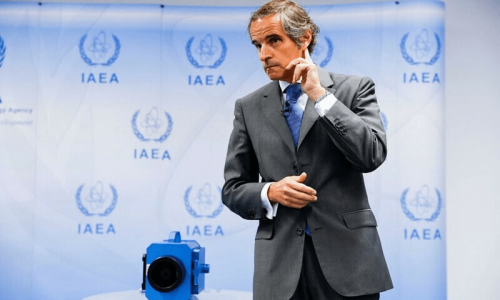
During a recent visit to Tehran by IAEA head Rafael Grossi, Iran agreed to the agency’s demand to cap its sensitive stock of near weapons-grade uranium enriched up to 60 per cent purity.
‘Doubts and ambiguities’
Iranian President Masoud Pezeshkian, in power since July and a supporter of dialogue with Western countries, has said he wants to remove “doubts and ambiguities” about his country’s nuclear programme.
In 2015, Iran and world powers reached an agreement that saw the easing of international sanctions on Tehran in exchange for curbs on its nuclear programme.
But the United States unilaterally withdrew from the accord in 2018 under then-president Donald Trump and reimposed biting economic sanctions, which prompted Iran to begin rolling back on its own commitments.
On Sunday afternoon, the United Kingdom confirmed the upcoming meeting between Iran and the three European countries.
“We remain committed to taking every diplomatic step to prevent Iran from developing nuclear weapons, including through snapback if necessary,” London’s Foreign Office said.
The 2015 deal contains a “snapback” mechanism that can be triggered in case of “significant non-performance” of commitments by Iran, allowing many sanctions to be reimposed.
Tehran has since 2021 decreased its cooperation with the IAEA by deactivating surveillance devices monitoring the nuclear programme and barring UN inspectors.
At the same time, it has increased its stockpiles of enriched uranium and the level of enrichment to 60pc.
That level is close, according to the IAEA, to the 90pc-plus threshold required for a nuclear warhead, and substantially higher than the 3.67pc limit it agreed to in 2015.
Published in Dawn, November 25th, 2024