Putin promises Africa ‘total support’ in anti-West pitch to continent


SOCHI: Russia is seeking to woo African countries this weekend at a summit in the Black Sea resort of Sochi, with President Vladimir Putin promising the continent “total support”.
Facing isolation in the West following its full-scale offensive against Ukraine, Moscow has tried to build new partnerships across Asia, Africa and the Middle East, promoting itself as a bulwark against what it calls Western domination on the international arena.
“Our country will continue to provide total support to our African friends in different sectors,” Putin said in a speech read out by Foreign Minister Sergei Lavrov to other foreign ministers and senior officials.
The Kremlin leader, not attending the conference, said Russia’s relations with Africa have been strengthening “more and more” in recent years.
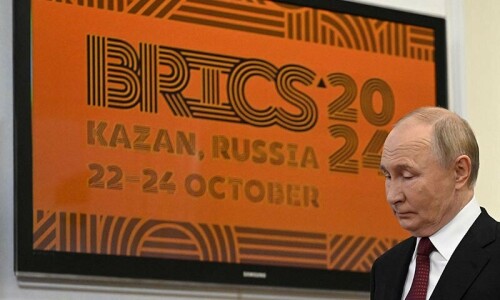
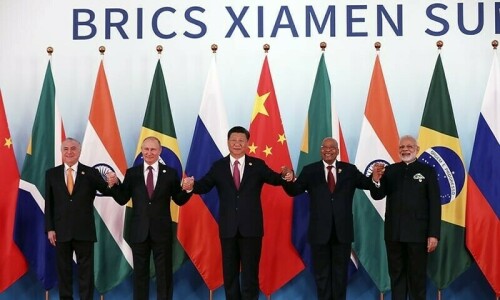
The conference is another chance for Russia to promote its vision of a “multipolar world” — a month after it hosted a BRICS summit of major emerging economies.
Russia was a major player in Africa in Soviet times and has been growing in influence on the continent in recent years, including militarily.
Three west African countries — Niger, Mali and Burkina Faso — have turned their backs on former colonial power France since coming under military rule following a string of coups since 2020 and have pivoted towards Moscow.
Russian mercenaries from the Wagner group or its successor, Africa Corps, now support several African governments and Russian “advisers” work with local officials.
In 2023, Russia delivered more than $5 billion in arms to Africa, according to the state company Rosoboronexport.
And major Russian firms also have significant investments in the continent, such as diamond miner Alrosa in Angola and Zimbabwe and the Lukoil energy giant in Nigeria, Ghana, Cameroon and Congo.
Russia ‘suits’ better
Russia’s narrative blasting Western “neocolonialism” is a message which resonates with some leaders across the continent.
“Russia is not a colonial power” and “has never been a colonial power”, said Mali’s Foreign Minister Abdoulaye Diop, on the sidelines of the Russia-Africa conference on Saturday.
“On the contrary, it has stood shoulder to shoulder with African peoples and other peoples around the world to help them emerge from the colonial system,” he maintained.
Russia was a major colonial power during the 18th and 19th centuries — though not in Africa — conquering territory in Europe, Siberia, the Caucasus and Central Asia to expand its borders across Eurasia.
Burkina Faso’s Foreign Minister Karamoko Jean-Marie Traore said partnership with Russia was a better fit for his country than its historic ties with France.
“The offer which has been made through cooperation with Russia, is better suited to the people” of Burkina Faso, he said in an interview on the sidelines of the Sochi summit.
Both are countries that have moved closer to Moscow following military coups, and where Russian military instructors are deployed to help in a decade-long fight against Islamist insurgents.
But Burkina Faso’s Traore dismissed the idea Burkina Faso could become too reliant on Moscow.
“There is no room for fear, because we know what we want and where we want to go. And we know how we want to work with our new partners,” he said.
But some analysts are sceptical as to how deep Russia’s interest really is.
In an interview, Bakary Sambe, director of the Timbuktu Institute in Dakar, questioned whether Russia’s involvement in Africa was a “real strategic priority” for the Kremlin. “Would Russia take the same interest in Africa,” he asked, if the conflict in Ukraine “came to an end?”
Published in Dawn, November 11th, 2024