UN’s Palestinian agency in limbo after Israel vote



JERUSALEM: The future of the United Nations Relief and Works Agency for Palestinian Refugees hung in the balance on Tuesday after Israel’s parliament banned UNRWA from operating in Israel and occupied east Jerusalem.
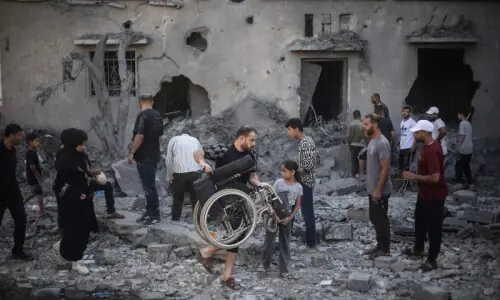
The measure provoked international outrage, and was seen as a political victory for those who accused UNRWA employees of taking part in the Oct 7, 2023 Hamas raid on Israel. What impact will the ban have on the hundreds of thousands of recipients of UNRWA aid in the Palestinian territories, including in war-ravaged Gaza? Here is what we know about the ban, which comes a year after the Gaza conflict began.
What will happen now?
UNRWA has provided aid, schooling and healthcare across the Palestinian territories and to Palestinian refugees elsewhere for more than seven decades. The new Israeli legislation forbids it from communicating and coordinating with Israeli authorities and bans UNRWA from inside Israel and occupied east Jerusalem. The ban is due to start in three months.
Agency’s spokesman says impacts cascade beyond what Israel considers to be sovereign territory
“The most immediate effect is to make it very difficult for UNRWA to continue its operations in east Jerusalem,” said Rex Brynen, a political scientist and expert on Palestinian refugees, referring to the Shuafat refugee camp in east Jerusalem.
But Jonathan Fowler, UNRWA’s spokesman in Jerusalem, said “the impacts cascade beyond what Israel considers to be sovereign territory”.
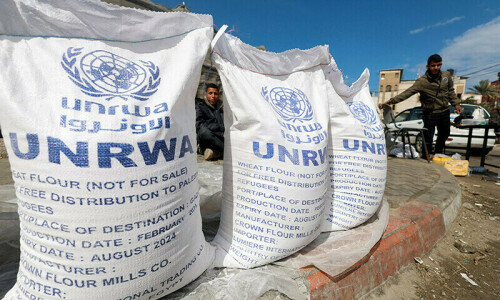
“Because it means that the end of coordination with Israeli authorities simply is an enormous blow to our ability to continue doing the aid operation in Gaza, of which we are the backbone.” UNRWA has 13,000 staff in Gaza and also manages the humanitarian response of other organisations. It is therefore in regular contact with Israeli authorities, notably regarding humanitarian aid.
Forbidding UNRWA from coordinating with Israel would also complicate its work in the occupied West Bank. There it serves 900,000 refugees, with 43 clinics and nearly 100 schools, Brynen said.
UNRWA recalled that its dealings with COGAT — the Israeli defence ministry body that manages civilian affairs in the Palestinian territories — concern employee movements, among other things.
Why does Israel want to ban it?
For Brynen, the legislation “has grown out of post-October 7 Israeli anger — most of it misdirected — at UNRWA”. But it “also reflects efforts over the years by the Israeli government and a variety of other MKs (members of the Knesset or parliament) to weaken UNRWA in an attempt to marginalise the broader Palestinian refugee issue”.
A major UNRWA critic inside Israel is former lawmaker Einat Wilf, who reproaches the agency for promoting the right to return for refugees. She claims that only a minority of those registered by UNRWA would be considered refugees “according to international norms”.
But the UN says individuals are considered refugees “until that refugee crisis is resolved”, British academic and refugee expert Anne Irfan said. “It is standard policy.” Irfan called the ban on UNRWA “indicative of quite a significant shift in Israeli policy”.
She said that previously Israel criticised UNRWA without calling its existence into question, because its work made “the cost of the occupation for Israel” cheaper.
Fowler said the ban was “an assault on the multilateral system, you know, all standards of UN resolutions, international court rulings”.
What could replace UNRWA?
UNRWA has existed for 75 years, and attempts to find a replacement have “failed miserably”, said its spokeswoman Juliette Touma.
“In international humanitarian law, it’s incumbent upon an occupying power to provide for the well-being to the greatest extent possible of a population under occupation,” Fowler said.
Some suggest that UNRWA missions could be taken over by foreign countries or other UN agencies. But Middle East expert Michael Dumper said: “Any attempt to restrict the role of UNRWA in the delivery of services will be seen as a way in which the international community’s commitment to that self-determination (of Palestinians) is being eroded.”
COGAT said that it encourages other UN agencies to operate in Gaza, but according to Fowler “they can’t scale up to do the kind of stuff that we do”.
The Palestinian Authority, which governs parts of the West Bank and seeks to secure a foothold in Gaza, has financial problems and would be incapable of taking over UNRWA operations.
Published in Dawn, October 30th, 2024