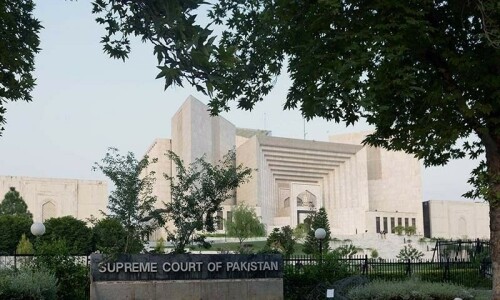
Will not follow court order on reserved seats: NA speaker

Speaker of the National Assembly Sardar Ayaz Sadiq said on Sunday that he would not follow the Supreme Court’s order on the reserved seats case, stating that he would wait for a decision by the Election Commission of Pakistan (ECP) before taking action.
Speaking on the Geo News programme ‘Jirga with Saleem Safi’, the speaker also said that the Supreme Court cannot challenge the recently passed 26th constitutional amendment, stating that doing so “would go against the Constitution itself”.
“It is the Election Commission’s job to notify members,” Sadiq said. “If we start listening to courts, there are many decisions … We won’t do it on the court’s order, we will wait for the ECP to notify it,” he added.
The speaker added that he would receive court orders, but would not act on them, instead wait for a notification from the ECP.
In July, the top court declared the PTI eligible to receive reserved seats for women and non-Muslims in the national and provincial assemblies, giving it a new lease on life in the legislature by declaring it a parliamentary party.
“The court told them (the PTI) that they could affiliate with a party after 15 days, so the PTI members went ahead and joined the SIC (Sunni Ittehad Council) … so floor crossing was allowed.”
Sadiq added that had the PTI candidates not joined the SIC, the position would be wholly different. “Instead, the court gave them 15 days, re-writing the Constitution.”
“Since we’ve amended the Constitution, they (the SC) have even less of a right to make rulings,” he added. “If the court said that we cannot take a decision because it’s backdated, we can respond that their decision was also backdated.”
Asked if he prefers the ECP over the apex court, the speaker said that despite being notified about court decisions, he preferred to wait for the former’s directions on an issue concerning parliamentarians.
“Once we receive a notification from the ECP, we apply our minds and take a decision,” he said.
Constitutional amendments cannot be challenged
Earlier this week, the SC was requested to strike down the 26th Amendment, with the petitioners requesting an inquiry by a judicial commission or any other forum to determine whether the two-thirds majority was voluntary or unlawful inducement was at play.
Sadiq slammed the decision by the SS, reiterating that the court “interprets the Constitution” but “cannot rewrite it”.
“It is baked into the rules,” he said. “The court cannot challenge constitutional amendments, that in itself would be violating the Constitution. However, the calls to challenge the amendment are growing quieter.”
‘There was no mystery behind the constitutional amendment’
Asked about the process of passing the 26th Amendment and the mystery surrounding it, the speaker clarified that there was a “lack of coordination” during the process.
“I don’t think it was mysterious, I think there was a lack of coordination,” he said. “Even when preparations were made, Maulana sb (JUI-F chief Maulana Fazlur Rehman) kept changing the time when he’d tell us his position … he’d say ‘I’ll tell you tonight’, then say ‘I’ll tell you tomorrow’.
“It did not help that sessions in parliament kept getting delayed from 3pm to 6pm,” he added. “We tried to make sure all parties reached a consensus, but it didn’t happen despite our efforts.”
Sadiq stated that passing the 26th Amendment was a month-and-a-half-long process. “I appreciate Bilawal’s effort to create consensus on this,” he said. “The prime minister also kept his team active on this and engaged with Maulana sahib and the PTI and SIC.”
The speaker also lauded Fazl’s “key role” in the amendment process, expressing hope that he and PPP chairman Bilawal Bhutto-Zardari could “bring in the opposition on future legislation as well”.
“I urge the government to bring a bill to the opposition first so that they can get their input,” he said. “Interacting like this will improve the working relationship between both sides.”
Asked if there are any amendments in the pipeline, the speaker responded that he has no knowledge of any proposed amendments.
“I have no knowledge of any amendments in the pipeline,” he said. “I don’t think there is a 27th amendment … if there were, we’d be told to make preparations and schedule sessions of parliament.”
During the interview, the speaker maintained that parliaments across the world have the option to appoint judges to the apex court. “Every parliament in the world has this power … in America, they hold congressional hearings to appoint judges,” he explained.
“If parliament can make Constitution, and judges interpret it, can parliament not appoint judges?” Sadiq asked.