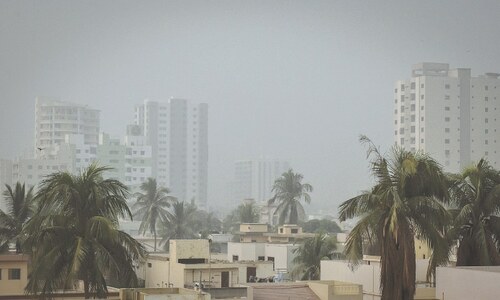
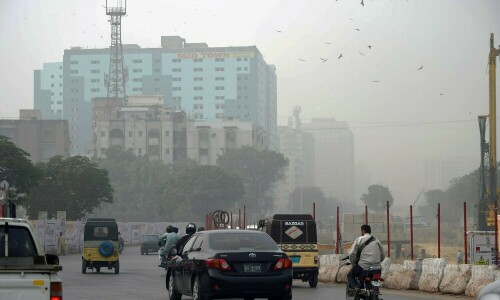
KARACHI: Expressing serious concern over the growing levels of air pollution affecting all major cities of Pakistan, a senior expert at a press conference held on Friday at the Aga Khan University (AKU) shared findings of a recent study conducted in Karachi, demonstrating a substantial increase in hospital admissions and ER (emergency room) visits for respiratory issues due to short-term exposure to ambient fine particulate matter (PM2.5) and its components (which are air pollutants).
The study titled ‘Impact of fine particulate pollution exposures on respiratory health in a mega city of Pakistan’ has recently been published in the journal Atmospheric Pollution Research.
The study — the first evidence of PM2.5 association with pulmonary diseases in a mega city of Pakistan— reveals alarmingly high levels of harmful particles in Karachi’s air.
High levels of sulfate, ammonium, nitrate, and black carbon have also been found widespread across the city that contributed to poor air quality.
Expert says its high time air pollution was treated as a crisis; calls for taking steps to curb rising levels of particulate matter in the air
“We have seen a 25 to 30 percent increase in hospital admissions and ER visits on a daily basis and found children under one year, adults above 65 years and people with compromised immunity levels very vulnerable,” said Prof Zafar Fatimi, Section Head, Environmental, Occupational Health and Climate Change, Community Health Sciences at AKU, adding that many patients admitted in critical condition couldn’t survive.
It’s a huge loss and economic burden not just for the families but also for the society as a whole. “Here, we are talking about hospital admissions. But, poor air quality affects everyone, including those with strong immunity levels. The harmful particles, we are inhaling all the time, are slowly affecting our bodily functions,” he said, adding that particulate matter pollution also impacted cognitive ability.
‘Highest risk’ to respiratory system
According to him, PM2.5, known to pose the highest risk to human respiratory system, is emitted in large quantities from anthropogenic activities, and has been proven to contribute to cases of chronic bronchitis, lung infections, and the worsening of pre-existing respiratory diseases.
Prof Fatimi cited the World Health Organisation (WHO) 2021 report according to which high levels of particulate pollution in Lahore would reduce life expectancy of children being born in the city by five to seven years.
Local problem
The AKU study measured levels of PM2.5 constituents at Karachi’s two busy sites; Korangi and Tibet Centre on M.A. Jinnah Road. During the same time period, data was obtained from the city’s three leading hospitals: the National Institute of Cardiovascular Diseases (NICVD), the Jinnah Postgraduate Medical Centre (JPMC), and the Aga Khan University Hospital (AKUH) for hospital visits for respiratory health issues.
Researchers have found out that the average PM2.5 levels in Karachi are among the highest compared to other cities in both developed and developing countries and its concentration exceeded guideline values set by the WHO.
“It is high time we treat air pollution as a crisis and adopt measures to curb the increasing levels of PM2.5 in our environment. Also, we must understand that air pollution, unlike climate change, is a local issue created by our mismanagement and can be effectively addressed within a year in the city.”
Road traffic and industrial emissions, he pointed, constituted major sources of pollution, while calling for creating public awareness, making policies backed by evidence and setting up a mechanism for their implementation.
Published in Dawn, October 26th, 2024