Chief of Iran Guards’ foreign arm appears in public after long absence


 0
0

TEHRAN: Iranian commander Esmail Qaani on Tuesday appeared in public after weeks of absence to attend the funeral ceremony for general Abbas Nilforoushan, who was killed last month in Lebanon.
Nilforoushan, a general in Iran’s Revolutionary Guards, was killed in an Israeli strike on Beirut alongside Hezbollah chief Hassan Nasrallah.
The funeral procession for the slain Iranian general began at the Imam Hossein Square in central Tehran on Tuesday morning, according to a live broadcast on state television.
Qaani — who heads the Quds Force, the Revolutionary Guards’ foreign operations arm — had disappeared from public view and was rumoured in some media to have been targeted in an Israeli strike on Lebanon.
He appeared on Tuesday at the funeral, clad in the Guards’ green military uniform.
Iran summons Hungarian envoy to denounce EU sanctions
Nilforoushan’s casket was paraded through the packed streets of Tehran after a funeral ceremony at Imam Hossein Square in the city centre.
Thousands attended the funeral procession, many of them carrying yellow Hezbollah banners and Iranian and Palestinian flags and chanting “Death to Israel”. Memorial services were held for Nilforoushan in Iraq on Monday.
His remains will be taken to a another farewell ceremony in Tehran later in the day before leaving for another procession in Qom, south of Tehran.
He will be laid to rest in his hometown Isfahan on Thursday after being taken to the holy city of Mashhad for another ceremony on Wednesday.
Iran’s foreign ministry said the Islamic republic would use “all its capacities” to bring Israel to account over the deaths.
Iran has in recent days engaged in high-level diplomatic talks around establishing a ceasefire in Lebanon and Gaza, as well as ways to prevent the conflict from spreading across the region.
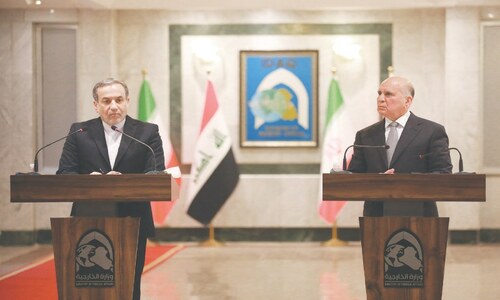
On a visit to Baghdad, Foreign Minister Abbas Araghchi said that Iran was “fully prepared for a war situation”, but added that “we do not want war, we want peace”.
In April Tehran had fired a volley of missiles and drones at Israel in retaliation for a deadly strike on Iran’s consulate in Damascus, blamed on Israel.
‘Strong objection’
Iran’s foreign ministry on Tuesday summoned the ambassador of Hungary, which holds the rotating presidency of the European Union, to condemn the block’s recent sanctions on the Islamic republic.
The ministry announced in a statement Iran’s “strong objection” and said “resorting to illegal and coercive methods such as sanctions against the Islamic Republic of Iran is not acceptable in any way and will lead nowhere.”
The 27-member union imposed sanctions on prominent Iranian officials and entities, including airlines, accused of taking part in the transfer of missiles and drones for Russia to use in its war against Ukraine.
The sanctions were slapped on seven entities, including Iran Air, and seven individuals, including deputy defence minister Seyed Hamzeh Ghalandari and senior officials of the Quds Force, the foreign operations arm of the Islamic Revolutionary Guard Corps or IRGC.
The ministry described the sanctions on Iran’s airlines as “a clear violation of the standards and regulations of international law, especially fundamental human rights and freedoms.”
It also defended the country’s “defence and military cooperation” as “legal and aimed at protecting the interests and national security of Iran” which is “not a matter that third parties are allowed to interfere in.”
European Commission President Ursula von der Leyen hailed the new sanctions in a post on the social media platform X and said Iran’s “support to Russia’s war of aggression against Ukraine is unacceptable and must stop.” Those Iranian entities and persons targeted in the sanctions are subject to an asset freeze and banned from travelling to the EU.
Tehran, however, has rejected Western accusations that it has transferred missiles or drones to Moscow for use against Kyiv. Iran’s economy is already reeling from biting US sanctions following the unilateral withdrawal of Washington in 2018 from a landmark nuclear deal between Iran and world powers.
Published in Dawn, October 16th, 2024