Churna Island: Pakistan’s biodiversity hotspot in danger


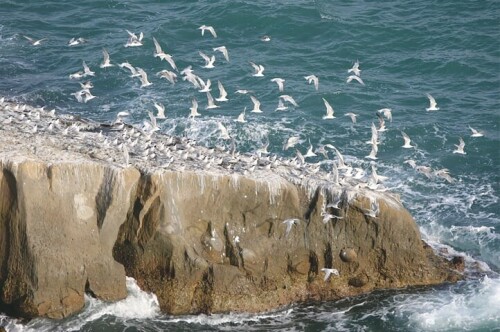
In early September, Churna Island was designated as Pakistan’s second-ever marine protected area in a bid to preserve its unique but eroding biodiversity.
Environmentalists view the island, located in the Arabian Sea some 40 kilometres from the commercial hub of Karachi, as a biodiversity hotspot with many rare marine species and coral formations.
They are warning of grave dangers to the island and its biodiversity, including increasing industrial activities, marine pollution, and illegal fishing.
“The island’s marine ecosystem and diverse wildlife are facing serious threats due to a string of anthropogenic activities, including the development of power plants, single-point mooring, an oil refinery in the immediate vicinity, and recreational activities in the area,” Muhammad Moazzam Khan, a technical adviser at WWF-Pakistan, told Anadolu.
He said the island is one of Pakistan’s most unique natural ecosystems, with a big coral habitat and serves as a basking and feeding ground for whales, whale sharks, mobulid rays, sunfish, and various other large fish.
The waters around the island are vital for thousands of fishermen from the southern Sindh and southwestern Balochistan provinces, who are also at risk of losing their livelihoods, he said.
Just a few hundred meters away from the island, there is a single-point mooring that delivers oil to a refinery, he added. “This is too risky. If there’s a spill someday, it could destroy the island,” said Khan.
Then there are two power plants, one of them a coal-fired facility, that give off dangerous emissions that have already started to affect the habitat, he said.
In 2022, he continued, the area saw coral bleaching for the first time in its history, presumably due to temperature anomalies caused by industrial activities.
Need for strict controls and protection
Syed Khizar Sharif, an environmentalist based in Karachi, highlighted growing marine pollution, illegal fishing, and unchecked tourism as the other major threats.
There is a serious lack of awareness about just how dangerous illegal fishing practices and marine pollution could prove for the island, he said.
On the tourism front, Churna is a popular destination for scuba diving, snorkelling, cliff jumping, jet skiing, and other such activities.
Sharif pointed out that there is no sort of monitoring when it comes to tourism, which is “very alarming” and should be addressed on an urgent basis.
“The delicate ecosystem and the coral reefs need proper protection, not just a declaration,” he told Anadolu.
Before Churna, the government of Balochistan declared Astola Island as Pakistan’s first marine protected area in 2017.
Sharifuddin Baloch, chief conservator at Balochistan’s Wildlife and Forest Department, told Anadolu that the provincial government aims to hold consultations with multiple stakeholders for preservation efforts.
“Provincial officials will negotiate with local and international companies to minimise the damage being caused by industrial activities around the island,” he said.
International firms have to fulfil certain obligations regarding environmental protection, and the Balochistan government will push for serious measures to mitigate the hazards, he said.
Baloch also cited “unmanaged” tourism as a key issue, along with a lack of monitoring of coral harvesting.
Churna has around 55 coral species, and local fishermen and tourists are both involved in illegally selling coral to private aquariums, mainly in Karachi, he said.
‘Declaration alone is not enough’
Designating Churna Island as a protected site is a vital step, but it is up to authorities to ensure that it leads to concrete measures, according to Sharif.
“The declaration alone is not enough to protect the habitat. There has to be a clear vision and a meticulous approach that includes strict enforcement of rules and regulations,” he said.
He cited the case of Astola, saying that “there were never any major steps taken to protect the area.”
A reason for optimism, said Sharif, is the geographical location of Churna, as it is much closer to Karachi than Astola.
“That should make it easier for the government agencies concerned to implement their monitoring mechanisms and take swift actions,” he added.