0
0
PESHAWAR: The Peshawar High Court on Wednesday reserved its judgement on multiple petitions filed by several chairmen and members of the board of governors of medical teaching institutions against their removal by the provincial government.
The development came as a bench consisting of Justice Ijaz Anwar and Justice Syed Arshad Ali heard detailed arguments of lawyers for the petitioners and provincial advocate general Shah Faisal Uthmankhel.
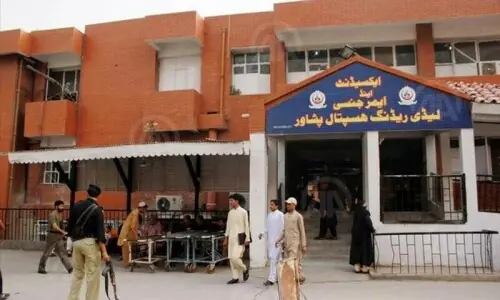
The petitions were filed by the chairmen of MTI boards, including Dr Umer Ayub Khan of the Khyber Teaching Hospital Peshawar, Abdur Rauf Khan of the Khalifa Gul Nawaz Hospital Bannu, Dr Mohammad Zubair of Lady Reading Hospital Peshawar, Malik Mushtaq Ahmad of the Maulana Mufti Mahmood Hospital DI Khan and board members from the Hayatabad Medical Complex Peshawar, Ayub Teaching Hospital Abbottabad, Qazi Hussain Ahmad Hospital Nowshera and other MTIs.
The petitioners had initially challenged the government’s decision to replace them and initiated a process of search and scrutiny of new members.
AG contends petitions not maintainable
On June 13, the high court issued a stay order directing the government to continue with its ongoing search and nomination process for selecting new MTI members across the province. It was, however , barred from replacing petitioners until further orders.
It later surfaced that the government had issued their removal orders on June 11, prompting some petitioners to file contempt pleas claiming that the government issued the notifications in back dates.
After many developments on the matter, the court issued another stay order on Aug 15 suspending notifications issued on June 11 and restoring the petitioners to their previous positions.
However, it declared that the officers restored to their positions should not make any appointments or procurements till further order.
Babar Khan Yousafzai, Barrister Babar Shahzad Imran, Mohammad Sangeen Khan, Rahmanullah Shah, Habib Anwar, Mohammad Arif, Mohammad Farooq Malik, Mohammad Arif Jan and other lawyers appeared for the petitioners and contended that the government orders of replacing the petitioners were illegal and against the KP Medical Teaching Institutions Reforms Act, 2015.
They said that their respective clients were mostly appointed in Dec last year as members of BoGs of different MTIs for a period of three years.
The counsel argued that the petitioners were appointed under Section 5(3) of the KP MTIRA, 2015, on the recommendation of the search and nomination council, which was constituted under Section 8 of that law.
The lawyers representing petitioner Dr Umer Ayub said that their client was appointed a member of the KTH BoG and was subsequently elected as its chairman.
They said that after the Feb 8 general elections the new provincial government had decided to replace the chairmen and members of MTI boards and assigned the task to the search and nomination council to make selection for these slots.
The counsel argued that the petitioners could not be removed from their posts without assigning any valid reason as they had been appointed for a period of three years.
They contended that the government had made new appointments on political basis so as to accommodate their favourites against these posts.
The lawyers argued that after assuming their charge the present BoGs had worked with utmost dedication resulting in improvement in the performance of different MTIs.
They added that prior to the controversial decision made by the government, the hospitals were being run smoothly under the overall supervision of BoGs.
The counsel, however, said that after a cabinet meeting of April 23 wherein despite matters of BoGs not being on the agenda, the same was discussed at length and it was decided to dissolve all MTI boards.
AG Shah Faisal Uthmankhel contended that these petitions were not maintainable and should be dismissed.
He argued that the petitioners should have moved the MTI Appellate Tribunal, which was the proper forum under the MTIRA for redressal of their grievances instead of approaching the high court.
Mr Uthmankhel argued that the law empowered the provincial government to dissolve any of the boards. He added that a member of the board could hold his office “during the pleasure of the government” and could be removed under the law.
He also questioned the powers of the caretaker government regarding the appointments of the members of MTI boards.
Published in Dawn, September 26th, 2024