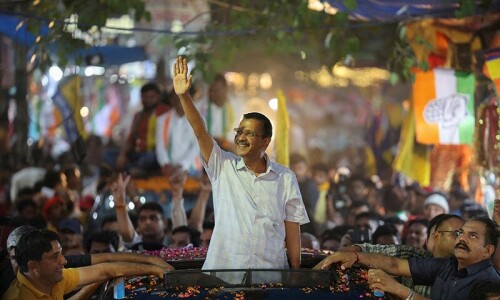
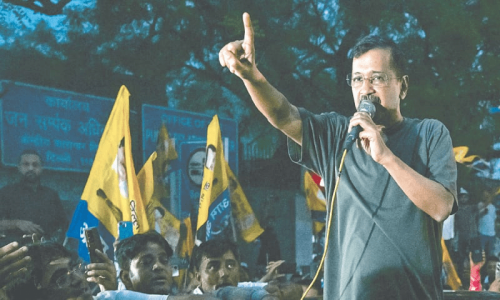
A top political opponent of Indian Prime Minister Narendra Modi was granted bail on Friday after months behind bars on accusations his party took kickbacks in exchange for liquor licences.
Arvind Kejriwal, chief minister of the capital Delhi and a key leader in an opposition alliance that battled Modi in national elections earlier this year, was first detained in March over the long-running corruption probe.
He is among several opposition leaders, with one of his colleagues describing his arrest at the time as a “political conspiracy” orchestrated by Modi’s ruling Bharatiya Janata Party (BJP).
A two-judge bench of the Supreme Court ruled that Kejriwal’s arrest was lawful but that he should be released from custody while contesting the charges against him.
“Prolonged incarceration amounts to unjust deprivation of liberty,” Supreme Court justice Surya Kant said in a verdict granting bail to Delhi Chief Minister Arvind Kejriwal.
Kejriwal had earlier been freed by the same court for several weeks to allow him to campaign in this year’s general election but returned to custody once voting concluded.
His government was accused of corruption when it implemented a policy to liberalise the sale of liquor in the capital three years ago, surrendering a lucrative government stake in the sector.
The policy was withdrawn the following year, but the resulting probe into the alleged corrupt allocation of licences has since led to the jailing of two top Kejriwal allies.
Rallies in support of Kejriwal, who has consistently denied wrongdoing and refused to relinquish his post after his arrest, were held in numerous other big cities around India after he was taken into custody.
Kejriwal, 55, has been chief minister for nearly a decade and first came to office as a staunch anti-corruption crusader.
He had resisted multiple summons from the Enforcement Directorate, India’s financial crimes agency, to be interrogated as part of the probe.
‘Target political opponents’
Modi’s political opponents and international rights groups have long sounded the alarm on India’s shrinking democratic space.
US think tank Freedom House said this year that the BJP had “increasingly used government institutions to target political opponents.”
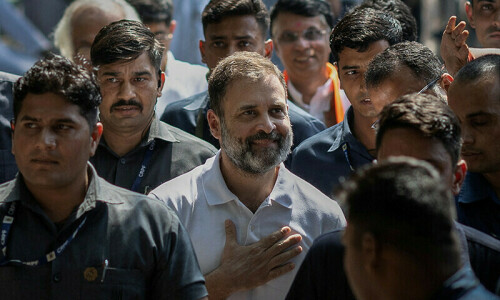
Rahul Gandhi, the most prominent member of the opposition Congress party and scion of a dynasty that dominated Indian politics for decades, was convicted of criminal libel last year after a complaint by a member of Modi’s party.
His two-year prison sentence saw him disqualified from parliament until the verdict was suspended by a higher court and raised concerns over democratic norms in the world’s most populous country.
Kejriwal and Gandhi are both members of an opposition alliance formed to compete against Modi and the BJP.