Afghanistan to begin work on TAPI gas pipeline



Afghanistan said on Wednesday work would begin on a $10 billion gas pipeline traversing South Asia as officials joined dignitaries in neighbouring Turkmenistan to celebrate its completion on that side of the border.
Progress on the TAPI pipeline — running through Turkmenistan, Afghanistan, Pakistan, and India — has been repeatedly delayed because of security issues in conflict-ravaged Afghanistan.
“From today the operations will start on Afghanistan’s soil,” Taliban government spokesman Zabihullah Mujahid said at the ceremony in comments broadcast by Afghan state television.
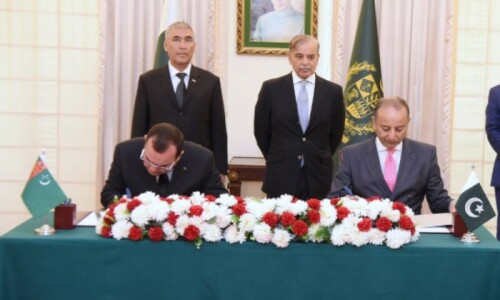
At the border ceremony in Islim Cheshma in Turkmenistan, officials on both sides, including Afghan Prime Minister Hassan Akhund, hailed the project.
“This project will benefit not only the economies of the countries participating but also the countries of the whole region,” Turkmen President Serdar Berdimuhamedow said in a video broadcast live at the ceremony.
In the Afghan border province of Herat, a public holiday was declared to mark the occasion, with posters celebrating the project plastered around the capital of the same name.
The pipeline will see around 33 billion cubic metres of natural gas each year extracted from the Galkynysh gas field in southeast Turkmenistan.
It will be pumped through an 1,800-kilometre pipeline traversing Afghanistan, including Herat and Kandahar in the south, before crossing into the Balochistan province in Pakistan and ending in Fazilka in Indian Punjab.
Pakistan and India will each purchase 42 per cent of the gas deliveries, and Afghanistan 16 percent, while Kabul will also benefit from lucrative transit fees of around $500 million per year, according to Afghan media.
Work on the Turkmen side began in 2015 and was initially scheduled to start in Afghanistan in 2018, but has been repeatedly delayed.
India’s commitment to the pipeline has also previously been questioned over its relationship with Pakistan and its already easy access to liquefied natural gas markets.
Jobs and cheap gas
The ceremony was an opportunity to simultaneously launch various bilateral projects, including a fibre-optic line to Herat, an electricity line, and the inauguration of a railway bridge.
In a country plagued by unemployment, TAPI “will provide jobs for 12,000 people in Afghanistan,” the government spokesman Mujahid told AFP.
Neither Afghan nor Turkmen officials have provided details on the financing or the expected date for TAPI to come online.
However, Swapnil Babele, an analyst with the research group Rystad Energy, expects further delays “as a lot of work remains to be done and the question of future financing is unclear”.
“We expect it to be operational only in the next decade,” he told AFP.
For the three recipient countries, the pipeline will have the advantage of “delivering gas cheaper than liquefied natural gas and ensuring consistent supply”.
It is the most significant development project for Taliban authorities since they seized power in 2021, ending their two-decade-long insurgency against the foreign-backed government.
The pipeline gives the government, which is not officially recognised by any nation, a strategic role in regional cooperation between Central Asia and South Asia, which is facing huge energy deficits.
Afghanistan, although still under economic and financial sanctions from the West, is currently trying to relaunch ambitious projects, particularly in energy, mines, and infrastructure.
At the end of July, Afghanistan and China officially relaunched a major copper extraction project in the world’s second-largest known deposit, near Kabul, which had been bogged down since 2008.