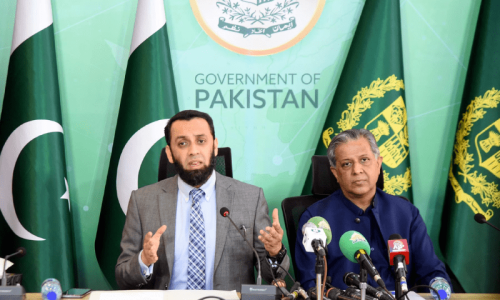
Information minister laments ‘lack of mechanisms’ to counter misinformation


Information Minister Attaullah Tarar on Wednesday lamented the “lack of mechanisms” to control and counter the spread of false information on digital platforms, stating that they cause damage to the country’s image and fragile economy.
Addressing an event in Islamabad, the information minister said that in the digital age, verification, and authentication had become “the two most important tools that provided people with a true perspective on what’s going on and what the reality is.
“If you look at the brief historical background, as far as newspapers and TV are concerned, you had some form of editorial control,” the minister said. “You had systems, training, and people well-equipped to deal with information and how to disseminate it.
“In the digital age, unfortunately, we don’t have mechanisms to authenticate and verify information and it causes a lot of damage and losses,” Tarar lamented, citing the example of how misinformation could damage Pakistan’s fragile economy.
“Our economy is very fragile and one small false news item can cause losses to the image of the country that can’t be measured,” he said.
Tarar stressed the need to impart training to digital journalists on how to verify and authenticate information online, in a similar vein to their counterparts in other mediums.
“Since I took office, I have advocated that we need to equip our journalists and digital freelancers with proper skills, so they can become ambassadors of this country and contribute towards the image building of this country and protect vulnerable groups,” the information minister said.
Continuing his speech, Tarar cited the example of how misinformation affected his constituency in Lahore, with a wedge allegedly being driven between Christians and the government by religious extremists.
“I have 70,000 Christian voters in my constituency,” he said. “When I reached out to them I could sense fear… I could sense they were insecure. I told them I would hold an open mic, we would sit down and discuss what the problems are.
“Some false information spread by religious extremists had created such a huge wedge between us and them that it took almost a week for me to convince them that this country is theirs as much as ours,” Tarar stated.
“People who spread false info are not our friends.”
The minister added that marginalised groups, in particular, were vulnerable to the spread of misinformation online, as at present, no mechanisms existed to protect them.
“They are at a loss because there is nobody to protect them and the spread of false information goes a long way in creating trust issues,” he said.
Tarar added that besides misinformation, the digital space was being used by terrorists to further their political goals.
“We have been helpless against this issue because certain groups acting against the safety and security of the nation… we have no means of countering them,” he said, highlighting that before the recent terrorist attacks in Balochistan, information about them had already spread on social media.
Tarar highlighted an initiative at the Ministry of Information that he dubbed “fact-check”, where the ministry will mark information that needs to be verified and “make it go viral” so that it could be authenticated. He added that the platform had existed for two years and was active on all social media platforms.
The information minister also said that Tech Valley, an organisation partnered with Google, will launch a programme to train journalists on how to verify reports online. Highlighting the widespread use of Google software within Pakistan, Tarar said that this training “will help build our society and bridge gaps we have between our communities”.
He expected this training to “eradicate religious extremism and hatemongering on certain social media platforms”.
“With the right amount of training and focus, we will be able to create an environment in which we will be able to provide harmony among our people,” Tarar said, reiterating his ministry’s commitment to working with these groups.
“The digital space can be used positively and negatively. With this training, we will not only create a positive image for our country but we will create a safe and secure environment for our people,” the minister said.
“In this day and age, it is a very important issue and requires a lot of focus and attention.”