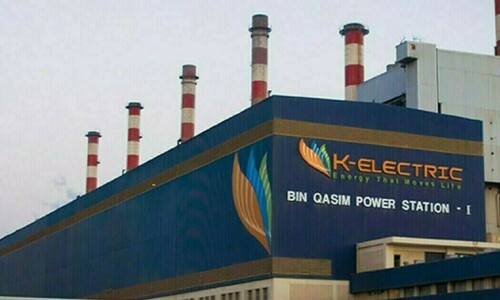
ISLAMABAD: Traders from Karachi have opposed the Rs3.09 per unit additional fuel cost adjustment (FCA) demanded by K-Electric, saying it would put them at a competitive disadvantage compared to the rest of the country.
The traders pleaded this on Thursday during National Electric Power Regulatory Authority’s (Nepra) public hearing on KE’s request for permission to extract Rs6.2bn from its consumers for electricity used in July.
The businesspersons, traders and political representatives from the city said the FCA for other ex-Wapda distribution companies was estimated to be negative Rs0.31 for July, the same month for which the power utility company was seeking an FCA of Rs3.09 per unit.
They said that since the government had applied uniform base tariff throughout the country and the difference was met through tariff differential subsidy, a higher FCA for Karachi would put business and industrial activities at a disadvantage.
Claim extra charges would put metropolis’ industry at competitive disadvantage
It would also encourage the relocation of industries to other parts of the country, particularly Punjab.
They were also almost unanimous that KE’s FCA should be frozen at around Rs1 per unit and defer the remaining part till the multi-year tariff for the utility company was determined and notified.
National Electric Power Regulatory Authority Chairman Waseem Mukhar, however, said the ex-Wapda Discos’s FCA for July turned out to be negative because the regulator had increased their base tariff, while KE’s multi-year tariff was in the process of being finalised.
The political and business leaders who appeared in the public hearing included Korangi Association of Trade and Industry’s Rehan Javed, Karachi Chamber of Commerce and Industry’s Tanveer Bari, industrialist Arif Bilwani, former KE executive Anil Mumtaz and Jamaat-i-Islami’s Imran Shahid.
They demanded that KE’s inefficient plants, which had an average fuel cost of Rs28 per unit, should be closed.
In their place, they demanded that surplus electricity from the national grid — at Rs9.04 per unit — should be diverted to Karachi, which would not only help the KE but also reduce the burden on consumers across the country who are paying for the capacity charges.
They also demanded heat rate tests of KE’s plants and criticised the government and the regulator for allowing the company’s old plants to remain in operation through repeated extensions and modifications even though their designed life had expired 15 to 16 years ago.
The participants also questioned the justification for Discos’ privatisation based on the same experience as KE.
Mr Bari of KCCI said consumers were paying for KE’s inefficient plants and a Rs33bn incremental package given to Discos’ consumers last year was not yet transferred to Karachi’s industrial consumers.
Nepra had recently allowed KE to charge an additional FCA of Rs2.59 and Rs3.168 per kwh for electricity consumed in May and June, respectively, through the billing months of October and November 2024.
FCAs are incurred by power utilities due to global variations in fuel prices and changes in the electricity generation mix.
The higher FCA is applicable to all consumer categories except, lifeline power consumers and protected domestic consumers — using up to 300 units — agricultural consumers and electric vehicle charging stations.
The adjustment on account of monthly FCA is also applicable to domestic consumers having Time of Use (ToU) meters, irrespective of their consumption.
Under the tariff mechanism, changes in fuel cost are passed on to consumers on a monthly basis through an automatic mechanism while quarterly tariff adjustments on account of variation in the power purchase price, capacity charges, variable operation and maintenance costs, use of system charges and including impact of transmission and distribution losses are built in the base tariff by the federal government.
Published in Dawn, August 30th, 2024