Inmates kill three guards in Russia prison siege

MOSCOW: Inmates killed three Russian prison guards in a siege on Friday, officials said, with the assailants having apparent connections to the militant Islamic State (IS) group.
Russian special forces stormed the facility in the southern Volgograd region and shot dead all four attackers after an hours-long stand-off.
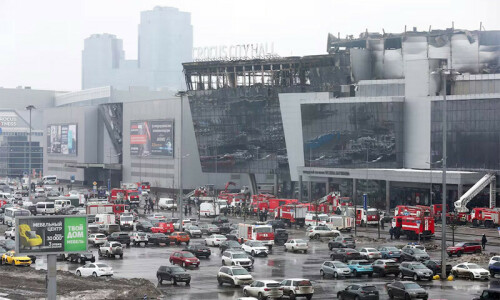
It was the second such case of IS-affiliated prisoners taking staff hostage since June and comes with ethnic tensions running high following the attack on a Moscow concert hall in March.
“Four criminals took eight colony employees and four convicts hostage,” Russia’s federal penitentiary service said Friday.
Authorities link the assailants to militant Islamic State group
The assailants stabbed the employees, including some who tried to resist. Three were killed and there were conflicting reports from officials over the fate of a fourth prison guard.
Russia’s National Guard said its snipers shot dead the hostage-takers in a “special operation” to end the siege. In addition to those killed, the attack left four prison guards hospitalised and wounded four other prisoners.
The standoff lasted several hours on Friday afternoon after the inmates took hostages during a disciplinary commission meeting at the prison colony, according to the Federal Penitentiary Service.
Videos published on Russian social media amid the siege appeared to show prison guards covered in blood and lying motionless on the floor.
The clips also showed the hostage-takers holding flags affiliated with the militant Islamic State group. Brandishing a knife, one said the attack was “revenge” for Russia’s oppression of Muslims following the Moscow concert attack in March.
While the incident was unfolding, Russian President Vladimir Putin said the “situation” would be discussed at a regular meeting of the country’s security council.
‘Ethnic discord’
Volgograd regional governor Andrey Bocharov alluded to reports on social media that the attackers were not Russian citizens, but did not confirm their identity.
“Everyone on our territory is obliged to respect and comply with the laws of Russia. We will not allow anyone to try to incite ethnic discord,” he said in a statement published by the regional administration.
An Islamic association — the Spiritual Administration of Muslims of the Russian Federation — said it “categorically rejected” the “atrocity” and claimed it was “inspired from outside Russia”.
The IK-19 prison colony is located in the town of Surovikino, around 850 kilometres south of Moscow. It is the second incident of prisoners with apparent IS connections taking hostages, following a similar siege at a jail in the southern Rostov region in June.
Russian special forces then killed most of the hostage-takers, detained one, and freed the guards.
Tensions over migration and ethnicity are running high in Russia following the attack on a Moscow concert hall in March that killed 145 people — the most deadly terror attack in Russia for two decades.
A Central Asian branch of IS claimed responsibility for the attack and the four suspected gunmen, now in pre-trial detention, are citizens of Tajikistan.
Millions of people from Central Asia, which was part of the Soviet Union, live in Russia, many working low-skilled jobs to send money back to their families.
The IS has repeatedly pledged to target Russia over its support of Syrian leader Bashar Al Assad, who has waged a military campaign to quash the group in the Middle East.
Published in Dawn, August 24th, 2024