• Govt okays export of sugar
• Ends Dar’s policy that linked sugar exports to domestic price stability
ISLAMABAD: The government approved a Rs20 billion “special allocation” on Thursday for Operation Azm-i-Istehkam, an initiative announced three months ago to combat terrorism and extremism.
The decision was made during a meeting of the cabinet’s Economic Coordination Committee (ECC), which also approved the export of 100,000 tonnes of sugar while exempting sugar mills from responsibility for domestic price hikes.
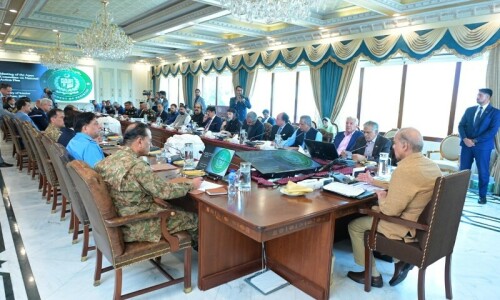
The ECC meeting, presided over by Finance Minister Muhammad Aurangzeb, sanctioned supplementary grants totalling Rs2.23bn for security forces.
Of this, Rs1.95bn was allocated to the Frontier Corps Balochistan (South) for security expenses related to the Reko Diq project, and Rs276.25 million to the Frontier Corps Khyber Pakhtunkhwa (North) for project implementation letters (PILs).
Operation Azm-i-Istehkam was announced on June 22 after a Central Apex Committee meeting of the National Action Plan. The operation aims to deploy the country’s full military, diplomatic, legislative and socio-economic resources to decisively defeat terrorism and extremism.
The announcement was met with fierce criticism from opposition parties — including the PTI, JUI-F and the Awami National Party — both inside and outside the parliament, with the KP chief minister even denying that any such thing was discussed with him during the apex committee meeting.
The intense opposition then prompted the government to clarify that the campaign, to be launched under the banner of Azm-i-Istehkam, would not be a kinetic large-scale military operation, nor would it entail the mass displacement of the local populace.
The country has witnessed an uptick in terrorism in the past year, especially in KP and Balochistan, after the banned Tehreek-i-Taliban Pakistan ended its ceasefire with the government in November 2022.
Azm-i-Istehkam is the latest in a series of counter-terrorism operations launched by the Pakistan Army since the mid-2000s. More recent operations include Zarb-i-Azb, launched in 2014 by Gen Raheel Sharif to combat militants in North Waziristan, and Raddul Fasaad, initiated in 2017 under Gen Qamar Javed Bajwa, to eliminate what was then described as “residual terrorist threats” in the country.
Sugar export
The ECC, at the request of Minister for Industries and Production Rana Tanveer Hussain, approved a major concession to sugar mills and their association — Pakistan Sugar Mills Association (PSMA) — by exonerating them from potential increases in sugar prices in the local market that normally move up on lower domestic stocks.
The provision was introduced about a decade ago by the ECC — then led by Ishaq Dar, who linked export permissions to price stability in the local market. All subsequent ECCs maintained this condition, and export permissions were suspended in case of domestic price hikes.
Sugar mills had long lobbied against this condition, arguing that market forces were beyond their control. They eventually persuaded the minister for industries during a Sugar Advisory Board (SAB) meeting on Wednesday that mills should only be held accountable for ex-mill prices, not market prices.
“The ECC approved the summary of the Ministry of Industries and Production” regarding the export of a further 100,000 tonnes of sugar, an official announcement said, adding the benchmark for retail price of sugar would be “delinked from the permission to export sugar as retail price is not directly under the control of sugar mills”.
The ECC relaxed an earlier condition that required the revocation of export quotas if sugar mills failed to pay growers from export proceeds. This condition will now apply only to non-compliant mills rather than the PSMA as a whole.
In yet another gift to sugar mills, the ECC extended the period allowed for exporting sugar from 45 to 60 days from the date of quota allocation by the cane commissioner.
The ECC also decided that export proceeds for sugar destined for Afghanistan must be received in advance through banking channels. For other destinations, export proceeds via letters of credit (LCs) are allowed within 60 days of the LC’s opening.
The committee decided to monitor the market situation monthly and review.
This decision followed a SAB meeting chaired by Rana Tanveer on Wednesday, which recommended exporting 100,000 tonnes of surplus sugar with the understanding that sugar mills would “ensure maintenance of ex-mill sugar prices”.
Published in Dawn, August 23rd, 2024