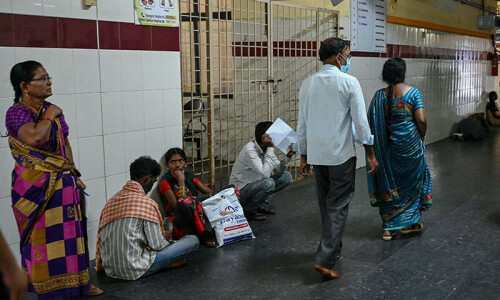
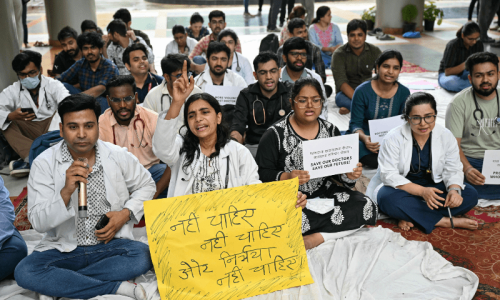
Some India doctors stay off job after strike over colleague’s rape and murder


Some Indian junior doctors remained off the job on Sunday, demanding swift justice for a colleague who was raped and murdered, despite the end of a 24-hour strike called by the country’s biggest association of doctors.
Doctors across the country have held protests and candlelight marches and have refused to see non-emergency patients in the past week after the killing of the 31-year-old postgraduate student of chest medicine around the early hours of August 9 in the eastern city of Kolkata.
Women activists say the incident at the British-era R.G. Kar Medical College and Hospital has highlighted how women in India continue to suffer despite tougher laws following the gang rape and murder of a 23-year-old student on a moving bus in Delhi in 2012.
“My daughter is gone but millions of sons and daughters are now with me,” the father of the victim, who cannot be identified under Indian law, told reporters late on Saturday, referring to the protesting doctors.
“This has given me a lot of strength and I feel we will gain something out of it.”
India introduced sweeping changes to the criminal justice system, including tougher sentences, after the 2012 attack, but campaigners say little has changed and not enough has been done to deter violence against women.
The Indian Medical Association, whose strike ended at 6am on Sunday, told Prime Minister Narendra Modi that as 60 per cent of India’s doctors are women, he needed to intervene to ensure hospital staff were protected by security protocols akin to those at airports.
“All healthcare professionals deserve peaceful ambiance, safety, and security at workplace,” it wrote in a letter to Modi.
But in Modi’s home state of Gujarat, more than 6,000 trainee doctors in government hospitals continued to stay away from non-emergency medical services on Sunday for a third day although private institutes resumed regular operations.
“We have unanimously decided to continue our protest to press for our demands,” said Dr. Dhaval Gameti, president of the Junior Doctors’ Association at B.J. Medical College in Ahmedabad.
“In the interest of patients, we are providing emergency medical services but not taking part in out-patient department or routine ward work.”
‘Could stop emergency services’
The government has urged doctors to return to duty to treat rising cases of dengue and malaria while it sets up a committee to suggest measures to improve protection for healthcare professionals.
Most doctors resumed their usual activities, IMA officials said, although Sunday is generally a holiday for non-emergency cases.
“The doctors are back to their routine,” said Dr. Madan Mohan Paliwal, the IMA head in the most populous state, Uttar Pradesh. “The next course of action will be decided if the government does not take any strict steps to protect doctors… and this time we could stop emergency services too.”
But the All India Residents and Junior Doctors’ Joint Action Forum said on Saturday it would continue a “nationwide cease-work” with a 72-hour deadline for authorities to conduct a thorough inquiry and make arrests.
Dr. Prabhas Ranjan Tripathy, additional medical superintendent of the All India Institute of Medical Sciences in the eastern city of Bhubaneswar, said junior doctors and interns had not resumed duty.
“The demonstrations are there today too,” he told Reuters. “There is a lot of pressure on others because manpower is reduced.”
R.G. Kar Hospital has been rocked by agitation and rallies for more than a week. Police banned the assembly of five or more people around the hospital for a week from Sunday and deployed police in riot gear.
Blocking meetings, demonstrations, and processions was justified to prevent “breach of peace, disturbances of the public tranquillity”, Kolkata Police Commissioner Vineet Goyal said in an order.
Reuters reporters saw no doctors at their usual protest site around the gates of the hospital on Sunday, as it rained in the area.