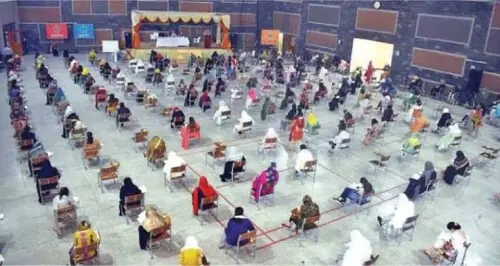
KARACHI: The importance of archiving was stressed upon at a seminar titled Reclaiming the Past held on Saturday at Frere Hall.
Artist Durriya Kazi moderated the event. She said Frere Hall was the perfect venue for such a programme because 159 years ago it opened its doors to the public. It’s continuously being used for cultural and literary events, as was its purpose.
In the pre-lunch session Bashir Sadozai, who has penned a book Baldia Karachi —Saal ba Saal, read out an insightful paper on ‘The magnetism of archives — connecting the past to the future’. He said the Urdu word for archive is daftarkhana. “For seven decades we have been under the influence of an elite which was created by colonial rule. After independence, its influence increased instead of getting decreased. Their demeanour and language are English. The common man is impressed by them therefore it’s better to talk about archives than daftarkhana. And this is the reason that the common man hasn’t yet been able to understand the importance of archiving.”
He said archiving has become a necessity all over the world. There is no better way to conserve the past and provide important information to the coming generations. “In Pakistan, to preserve culture and history, an institute was set up in 1951 which is now the National Archives of Pakistan. It is claimed that it contains rare and precious manuscripts and journals etc. Sindh Archives is a continuation of it and ever since it shifted to a building in Clifton the speed of its work has upped. Its keepers say that it has a vast and invaluable collection of historical material, including a gazette notification of 1843 in which Charles Napier was appointed governor of Sindh after which Sindh officially became a British colony.”
Mr Sadozai said we see British rule as the daur-i-ghulami, but its other aspect is that before the arrival of the British in the region, no such thing is found which could point at Karachi’s development or add to archival material. In their 108-year rule over Sindh, the British did some work. For example, he argued, “Old Karachi today lies in ruins. Where are its archives? The way old buildings in Karachi are being demolished to make way for ‘towers’, it indicates soon there will be nothing left and there will be no archives to document them.”
He pointed out that books written on Karachi either are personal reflections or don’t contain the complete information. He added a pressure group could be created of those who have been working on archives and they along with members of civil society can to go to the authorities concerned to highlight the importance of preserving and conserving heritage.
Humera Fatima’s topic was ‘The library as a space of social cohesion’. She basically talked about the British Council libraries in Karachi and Lahore, mainly about the former.
She said, “In 2016 when the library was incepted, the idea was to create a space which is not your place of work, which is not your place of education. It’s a place where you should come and network. It’s like a community centre.” She then gave a detailed account of how the library in Karachi works, how one can be its member and the facilities that it offers.
Graphic designer Saima Zaidi gave a presentation on Khaliqdina Hall and Library with emphasis on how a project called The Reading Room is helping revitalise it. She said Khaliqdina Library was built in 1906. A philanthropist Ghulam Husain Khalikdina made the hall and library primarily for locals to engage in literary pursuits and recreational activities. It was also the venue for the 1921 trial by the British against the Khilafat Movement.
She said in July 2023 it was noticed that the library’s interior needed care. In the latter part of her talk, she informed the audience on the work that has so far been undertaken in that regard.
Metropolitan Commissioner Afzal Zaidi was supposed to deliver the welcome address. He couldn’t turn up.
The post-lunch programme included topics such as research induced preservation of archives; archive, artistic research and speculative itinerancy; and mobilising the archive through creative practice.
The event was organised by Numaish Karachi in collaboration with the KMC.
Published in Dawn, August 11th, 2024