0
0

• Law minister says this should not be considered ‘compensation’
• Says 1,000 cases to be prioritised on a ‘first come, first served’ basis
• Defends spy agencies, says there are several reasons behind disappearances
ISLAMABAD: The government on Friday announced a “support package” of Rs5 million each for the families of missing persons, which would provide them with legal and financial assistance.
Earlier this week, the government notified a three-member committee comprising top intelligence officials to help with the recovery of missing persons, after the Islamabad High Court (IHC) ordered it to do so in February.
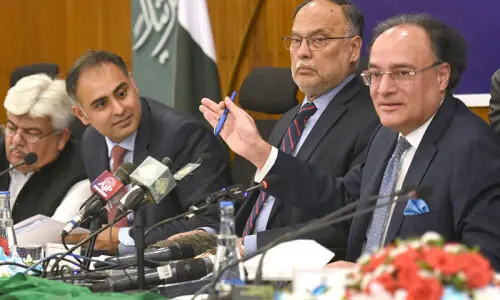
Addressing a press briefing in Islamabad, Law Minister Azam Nazeer Tarar said that a report, based on the findings of two previous cabinet committees, had been presented to the Cabinet Committee for Missing Persons during the caretaker government’s tenure.
He added that the report was presented before the federal cabinet on Friday and some of its salient recommendations have been approved.
He said that families of missing persons face several economic problems, therefore, in view of those issues, the cabinet had decided to provide an urgent support to them after due diligence.
“A special committee will be formed to determine which families need an immediate support package, after which each [eligible] family will receive Rs5 million,” Mr Tarar said.
He detailed more than 2,000 cases “determined by legal mechanisms that were facing some hardships”, and of which 1,000 would be prioritised on a ‘first come, first served’ basis, beyond a five-year limit.
However, he did not specify the number of families that would be provided with the support package.
Mr Tarar further said that the prime minister has formed a committee to determine the process for disbursement of the package.
“Keep in mind that this is not a compensation of any kind, as there is no compensation for a human life,” the law minister clarified, adding that the package was being given as a “support” to such families considering their “hardships until the matter is resolved”.
“May God have the person return and reunite with their families, then this would not be an amount to be reclaimed. […] We say that the state is like a mother so the state has some responsibilities for its citizens.”
Mr Tarar termed it “welcoming” that the report stated with “clarity […] that there was positive cooperation from [intelligence agencies] and they also want this matter resolved within a legal framework”.
He noted that “more finger-pointing was carried out [towards intelligence agencies] that maybe it happened because of them, even though there are numerous reasons for missing persons and statistics are also available”.
He explained that recommendations on other related matters were also made, including the possible legal framework, future strategy to prevent such cases, and necessary instructions to the National Database and Registration Authority (Nadra) to take care of issues pertaining to missing persons’ bank accounts and inheritance.
The minister noted that for many years, it had come under discussion “what the reasons [behind the disappearances] are and what the involvement of state agencies is”, adding that the commission formed under the Supreme Court’s directives has been functional for more than a decade.
He recalled that members of a committee formed in May 2022 under the PML-N-led coalition government had visited Quetta and talked to the affected families.
He added that the caretaker government also formed a similar committee and “sought input from our intelligence agencies, state, and military institutions”.
Background
The measures announced on Friday are the culmination of a process that can be traced back to the first judicial commission on missing persons, headed by retired Supreme Court Justice Kamal Manzoor Alam.
That commission was one of the first forums where the issue of maintenance, i.e. supporting the family of a missing person during their disappearance, would come up. But it would be many years until the matter made it into policy, as the subsequent commission of inquiry under retired Justice Javed Iqbal did not broach the subject.
In 2018, then IHC Chief Justice Athar Minallah had raised the issue during hearings of the Maira Sajid case. The question posed then was how the family of a victim of disappearance could be expected to cope financially.
The matter, subsequently clubbed with other cases — such as that of journalist Muddasir Naru — recently saw IHC Justice Mohsin Kayani handing out ‘fines’ akin to punitive damages, to the defence and interior secretaries, Islamabad chief commissioner and police officers. Although the government had challenged the order, the appeals were turned down.
Published in Dawn, August 3rd, 2024