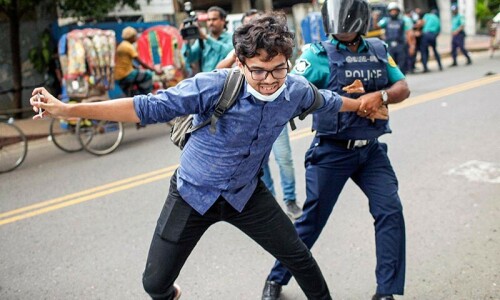
DHAKA: Bangladesh police freed six student leaders on Thursday whose campaign against civil service job quotas sparked deadly nationwide unrest, as the government looked to calm tensions and forestall fresh demonstrations.
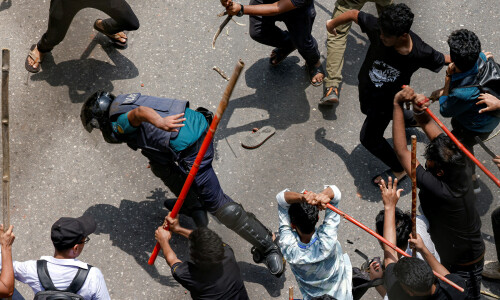
Students Against Discrimination staged nationwide rallies last month that ended in a police crackdown and the deaths of at least 206 people, according to an AFP count of police and hospital data.
The group’s leadership were among thousands picked up in the police dragnet that followed some of the worst unrest of Prime Minister Sheikh Hasina’s 15-year tenure.
“All six quota movement coordinators have been returned to their families this afternoon,” deputy commissioner Junaed Alam Sarkar said.
At least 206 people have died in protests against job quotas
Principal leader Nahid Islam and two others were forcibly discharged from a hospital in the capital Dhaka last Friday by plainclothes detectives and taken to an unknown location.
His father Badrul Islam confirmed to AFP that Nahid Islam had returned home early Thursday afternoon but did not give any more details.
Three others were detained in the following days, with the government saying they had been held for their own safety.
Justice minister Anisul Huq told AFP on Thursday that all six had volunteered to be in police custody.
“They came willingly. They said they wanted to go. They are allowed to return to their parents,” he said.
Hasina’s government restored order after deploying troops, imposing a curfew and shutting down the mobile internet network across the country of 170 million for 11 days. More than 10,000 people were arrested in the wake of the unrest, according to Bangladeshi media.
‘Arbitrary and unlawful’
Small and scattered protests resumed in cities around Bangladesh this week after other members of Students Against Discrimination ended a moratorium on demonstrations.
They vowed to restart their campaign after the government ignored a Monday deadline for their leaders to be freed.
“Their detention was arbitrary and unlawful. There was growing national and international criticism,” University of Oslo researcher Mubashar Hasan said.
He said the release of the student leaders signalled the government was looking to “de-escalate tensions” with the protest movement.
Published in Dawn, August 2nd, 2024