Lebanon on alert as Israel warns of ‘severe’ response to strike in Golan Heights


 0
0


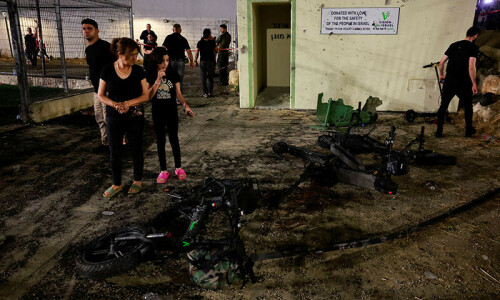
MAJDAL SHAMS: Israeli Prime Minister Benjamin Netanyahu on Monday vowed a “severe” response to a strike that killed youths in the annexed Golan Heights, as diplomats raced to contain escalation between Israel and Hezbollah.
On a visit to the site of the rocket strike which killed 12 children in the town of Majdal Shams, Netanyahu said: “The state of Israel will not, and cannot, let this pass. Our response will come and it will be severe.”
He was greeted by protests during his visit, which came after mourners gathered in the Druze Arab town for the burial of the last victim, 11-year-old Guevara Ibrahim.
Israel and the United States have blamed the strike on Hezbollah, which has traded near-daily fire with Israeli forces since the start of the Gaza conflict in early October.
Protests greet Netanyahu during his visit to the site of rocket attack
Lebanese Foreign Minister Abdallah Bou Habib said a flurry of diplomatic activity has sought to contain the anticipated Israeli response.
“Israel will escalate in a limited way and Hezbollah will respond in a limited way… These are the assurances we’ve received,” Bou Habib said in an interview with local broadcaster Al-Jadeed.
The United States, France and others were trying to contain the escalation, he added, while Lebanese Prime Minister Najib Mikati said that “talks are ongoing with international, European and Arab sides to protect Lebanon and ward off dangers”.
On Monday White House National Security Council spokesman John Kirby said he was “confident” a broader war can be avoided.
Italy’s Foreign Minister Antonio Tajani said he had spoken to Habib and Israeli Foreign Minister Israel Katz and told them it was “possible to interrupt the spiral of violence and it must be done now”.
But in the centre of the city, shop owner Muhammad Saad, 53, said life was going on as usual. “We’re already at war, what more could happen?” he said.
Hezbollah has denied responsibility for the Majdal Shams rocket attack, though the group claimed multiple strikes on Israeli military positions that day. Israel said Hezbollah fired a Falaq-1 Iranian rocket. This type of projectile is unguided and an analyst called them inaccurate weapons.
Gaza situation
On Sunday, Israel’s security cabinet “authorised the prime minister and the defence minister to decide on the manner and timing of the response”, Netanyahu’s office said.
Hezbollah has evacuated some positions in south and east Lebanon, a source close to the group said. On Monday, Hezbollah said it had launched “dozens of Katyusha rockets” at an Israeli military site following the killing of two of its fighters.
A source close to the group said the pair were killed in an air raid on Lebanon’s southern village of Mais al-Jabal. The cross-border violence has already killed more than 500 people in Lebanon, most of them fighters, and dozens of civilians and soldiers on the Israeli side.
Months of effort have failed to secure a ceasefire and prisoner release deal, though mediators and Israeli negotiators met on Sunday in Rome to discuss the latest proposal.
“The negotiations on the main issues will continue in the coming days,” an Israeli statement said. Hamas, however, again accused Netanyahu of hindering negotiations. In a statement, the group said he has set new conditions in “a retreat” from an earlier draft.
On the ground in Gaza, the Israeli military said its forces were continuing “precise” operations in the Rafah area and in nearby Khan Yunis. Israeli aircraft struck 35 targets across Gaza in 24 hours, the military added.
In the territory’s north, Hamas’s armed wing said its fighters were “engaging” an Israeli force in Gaza City’s Tal al-Hawa district, where witnesses reported shelling.
Philippe Lazzarini, head of the United Nations agency for Palestinian refugees, UNRWA, said “only 14 percent” of areas in Gaza are not under Israeli evacuation orders.
Published in Dawn, July 30th, 2024