Granite extraction planned from area near Karoonjhar Hills


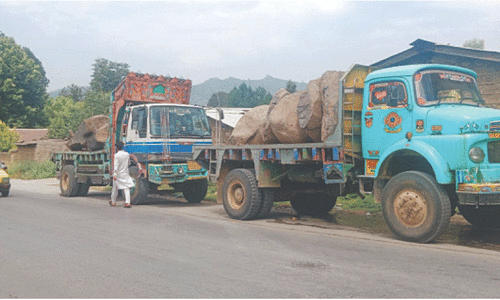
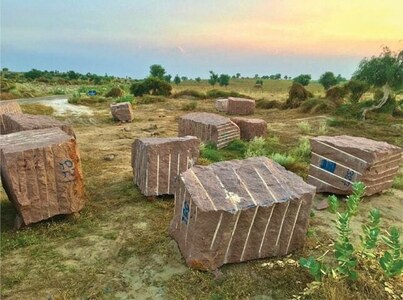
KARACHI: In an attempt to protect the entire Karoonjhar Hills as a cultural and heritage site, forest, and wildlife sanctuary, the Sindh cabinet on Thursday designated a 3.6 square kilometres area, located 25 km from Nagarparkar for granite mining, subject to clearance from the forest and wildlife department.
According to a press release, the cabinet meeting, held with Chief Minister Syed Murad Ali Shah in the chair, was informed that the Sindh High Court had on October 16 2023 banned excavation in Nagarparkar due to the presence of cultural and heritage sites, forests and Ramsar site.
It was further informed that the provincial government had filed an appeal against the SHC judgement in the Supreme Court which was informed that any government policy for mining in Karoonjhar hills would consider the competing interests of wildlife/forest, environment, and heritage.
The mines and mineral department told the cabinet that the Geological Survey of Pakistan’s (GSP) 2015 report said that there were around 14 billion tonnes of granite in Nagarparkar spread over 11 different locations.
Cabinet designates 3.6 sq km for mining, subject to clearance from forest dept
The cabinet was informed that a proposal was initiated by the caretaker government to launch the granite excavation project at Nagarparkar.
The cabinet committee identified the Khasar Area, located 25 km away from Nagarparkar, where the potential for granite excavation indicated an area of 3.6 sq km, as per the GSP Report 2015.
The committee found that the Khasar Area had no overlapping with forest areas. Subsequently, the cabinet approved Khasar as a granite mining area subject to the clearance of the Forest and Wildlife Department.
Later, at a post-cabinet press conference, Information Minister Sharjeel Memon and Education Minister Syed Sardar Shah said that the issue of mining in Nagarparkar had persisted for a long time.
The information minister said that mining would not proceed without the consent of the local residents, reflecting the core vision of the Pakistan Peoples Party’s leadership.
Sardar Shah clarified that the caretaker mines and mineral minister had proposed generating significant funds through the export of granite, but this plan was deemed impractical and opposed by the local community.
“Nagarparkar granite mining site has already been designated as a cultural and heritage site and it is firmly established that there are no plans to permit mining in Karoonjhar,” he added.
The minister said that the cabinet had decisively resolved to safeguard this historical heritage, ensuring that both Karoonjhar and Nagarparkar remained completely secure.
On the recommendation of the health department, the cabinet approved a Rs3.84 billion grant-in-aid to the Patients Aid Foundation for the procurement of medical equipment and supply of utilities for a new 12-storied 532-bedded medical complex JPMC.
The cabinet was told that a certain number of affectees, whose houses had collapsed during the floods, were excluded during the joint survey.
Since the validation was the purpose, inclusion was not encouraged. The CM said that there were 15,000 cases of inclusion lying with the Sindh People’s Housing for Flood Affectees (SPHF).
The CM with the consent of the cabinet directed the CEO of SPHF to start considering the cases excluded earlier.
In an important decision, the CM on the instructions of Chairman Bilawal Bhutto Zardari also decided that people with houses on government land near the flood-affected areas would be given land titles.
Published in Dawn, July 12th, 2024